

April was a busy month across Steam, PlayStation, and Xbox. New IP from Capcom and the team behind Windrose put up big numbers in their debut windows, Crimson Desert‘s post-launch tail held up well, EA Sports FC 26 leveraged a smart PlayStation discount cycle ahead of the World Cup, and Slay the Spire 2 quietly continued its early-access march toward 7M copies sold.
Let’s look at some Alinea copies sold estimates across all three platforms in April 2026, followed by an excerpt from last month’s client-exclusive newsletter on what Slay the Spire 2‘s Chinese review score is actually telling us about the Mainland market.
Let’s get into it.
The April top 5 by copies sold - Xbox, Steam, and PlayStation
Windrose was the top game by copies sold in April, moving 1.7M units in its debut month. Like Slay the Spire 2 in March, Windrose took the top spot across Steam, PlayStation, and Xbox despite only being available on Steam. The title has since hit 1.9M copies sold and $44M in gross revenue, and is on track to cross 2M imminently. About 15% of its players have played for over 50 hours. DAUs are declining at the expected post-launch pace, but Windrose still pulls in over 250K daily players on a weekday. Smooth sailing. You can catch our write-up on Windrose’s launch here.
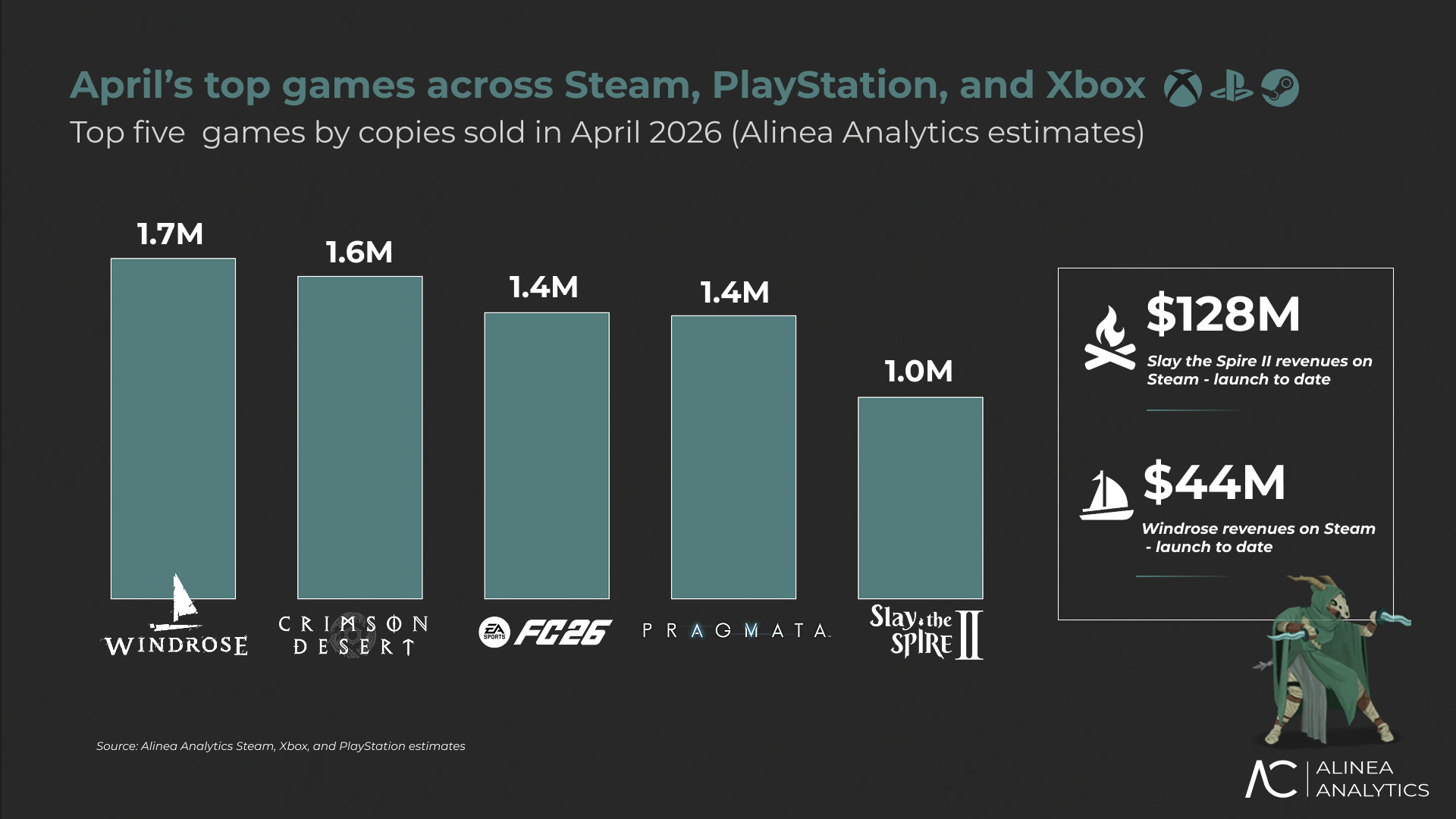
Crimson Desert continued to perform extremely well in April after its debut back in March, selling another 1.6M copies. About 1M of those came via Steam, almost 450K via PlayStation, and the remainder via Xbox (console, Windows, and cloud). Around a quarter of players across platforms also played Dragon’s Dogma II. People of taste. Relatively speaking, console players have sunk the most time into Crimson Desert, with 20% across Xbox and PlayStation having played for 100+ hours already, against 13% on Steam. The word-of-mouth-driven sustained engagement curve is the real story here, and it’s the reason Crimson Desert is still moving units in volume two months past launch rather than falling off the typical AAA … Kliff.
EA Sports FC 26 scored another 1.4M sold in April, boosted by its deepest discount yet on PlayStation ($21), which ran until April 9. The PlayStation version accounts for about 850K of those April copies, with Xbox and Steam each selling another 270K. Of those who played FC 26 on PlayStation in April, 29% also played Fortnite that month, while 20% played Rocket League, the top two crossover titles. Epic stuff (love a double entendre). FC 26 also brought in another 1M players via PS Plus Essential since being added as a monthly title a couple of days back. A very smart time to get players in the door, and spending, ahead of the FIFA World Cup.
Pragmata, Capcom’s new IP, also sold through (so no unsold retail copies) 1.4M across PlayStation, Xbox, and Steam in its launch month. About 840K of those came via Steam, almost 500K on PS5, and almost 100K on Xbox. Across all three platforms, around 40% of Pragmata players also played Resident Evil Requiem. As we mentioned in our Pragmata launch post, Capcom is cashing in a decade of quality, and the success of new IP Pragmata reflects that. Players who buy games in launch month, an important and lucrative cohort, trust Capcom in a way they trust very few publishers right now.
Slay the Spire 2 takes the number five spot via Steam alone while still in early access. The awesome roguelike deckbuilder shifted another 1M copies last month to pass 6.4M sold overall, generating almost $130M in gross revenue since its early-access launch two months ago. As we discussed in the Slay the Spire 2 launch post, China is the game’s top market, and this is having a significant and underappreciated impact on its review scores. More on that below.
An excerpt from last month’s client-exclusive newsletter
Last month’s client-exclusive Playbook newsletter went deep on Chinese user review divergence, as well as DLC data, Game Pass and PlayStation Plus deltas, and monthly player crossover on PlayStation (we’ve added Xbox now, too, with Steam on the way very soon). Below are excerpts from the China review part of that client newsletter.
When a single territory commands over a third of your copies sold, like with Slay the Spire 2 on Steam, its sentiment stops being a regional quirk and becomes a core business pillar.
Which makes the following Slay the Spire 2 Steam user review data worth sitting with:
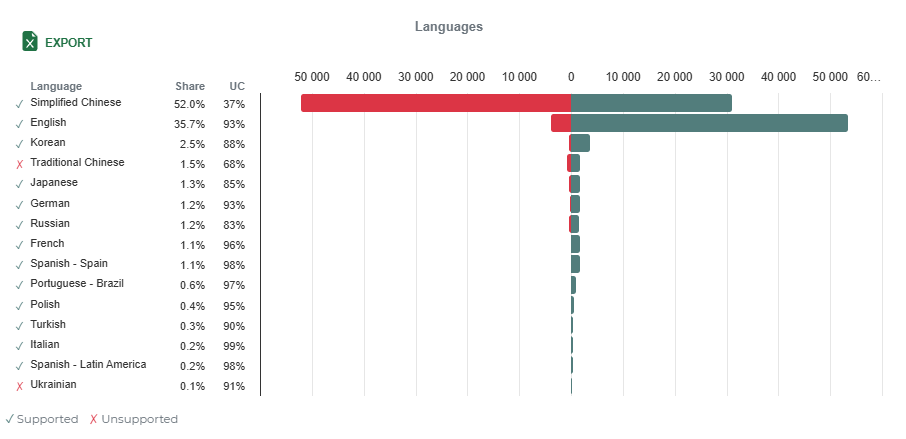
A 37% positive score in Simplified Chinese.
A 93% positive score in English.
The gulf between those two numbers tells you more about the Chinese market than any single data point we could offer.
To understand why, we need to understand how a meaningful segment of Chinese players actually plays Slay the Spire 2. In parts of the core Mainland China community, the pursuit of win-streaks and “infinites”, finding and exploiting overpowered card combinations, is a primary source of social pride and, for many players, the entire point of the game.
For context, I love Slay the Spire 2 (100 hours and counting…), and I’m quite tuned into its community.
When Mega Crit released its March 19 update, which made infinites harder to achieve and weakened several cards to establish a more balanced baseline, English-speaking reviewers largely shrugged. Early access balance changes are expected. But the Simplified Chinese score plummeted within days. The same thing has happened with the latest patch, too. The pattern is visible on the review tab of our Slay the Spire 2 Steam page.
For part of the China cohort, Mega Crit devalued the skill these players had spent hundreds of hours building. The review score is the response.
Conventionally, high playtime is a sign of a player who likes a game. If you’ve played 250 hours, you clearly like the game, right? Right? Thanks to its audience’s demographics, Slay the Spire 2 inverts that logic almost completely:
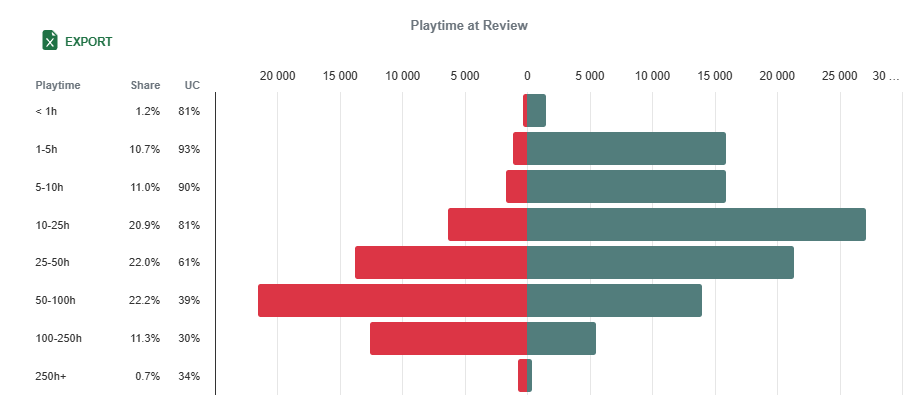
Players in the 1-5 hour range sit at 93% positive.
Players in the 100-250 hour range sit at 30% positive.
These late-game negative reviewers, mostly based in China, are using playtime as a badge of authority to demand changes, and they are reviewing the most recent patch rather than the core product.
For a publisher reading a global Mixed score without this context, the instinct is to panic or overcorrect. The data tells a more precise story. The negativity is concentrated in a specific, identifiable cohort with a specific, identifiable grievance. It’s also why Steam now surfaces reviews to users based on their local market by default.
But there are also meaningful differences within the Chinese-language reviews themselves.
Simplified versus Traditional: Two different conversations
To manage this volatility, publishers should treat Simplified and Traditional Chinese reviews as distinct data streams rather than a single Chinese bloc.
The geographic logic matters here:
Simplified Chinese is the written standard in Mainland China.
Traditional Chinese is used primarily in Taiwan, Hong Kong, and Macau.
Whilst Simplified Chinese is also used in Malaysia and Singapore, English remains the dominant written language in both countries, so Simplified Chinese reviews skew heavily toward Mainland players in practice.
Our platform separates these precisely because they behave differently, and for reasons that go beyond preference.
For Slay the Spire 2, Traditional Chinese reviewers are 68% positive, sitting somewhere between the Mainland score and the rest of the world (as is typical). Simplified Chinese reviewers sit at 37%. That gap reflects a structural difference in how Mainland players relate to developers in the first place.
The most direct factor is access. Discord, Reddit, X, and other community features are blocked in Mainland China. In Western markets, these channels absorb the bulk of player frustration. Complaints get posted, developers respond, and Steam reviews remain closer to purchase guidance.
In Mainland China, those outlets simply don’t exist. Steam reviews have become the normalised substitute, functioning as a primary feedback mechanism rather than a purchase signal.
This has become ingrained behaviour rather than a workaround. Mainland players tend to discuss games and share opinions on domestic platforms like Heybox and Tieba, then turn to Steam reviews specifically to direct criticism at developers.
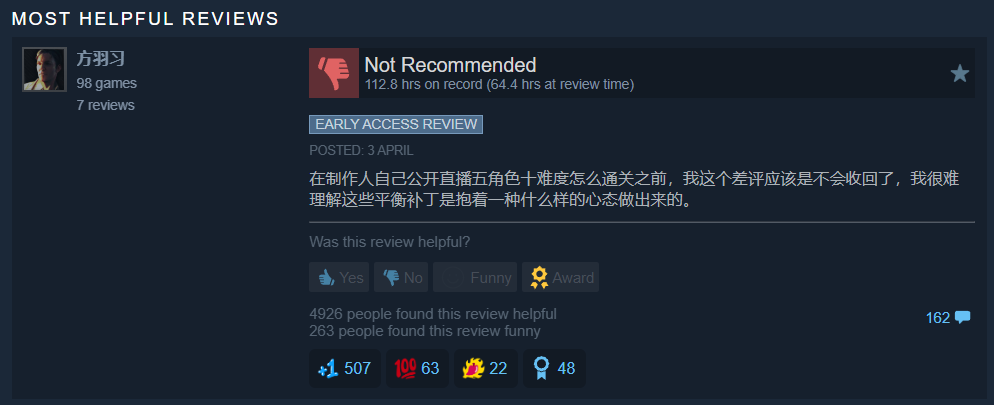
The review section functions as a complaints department as much as a storefront. Steam itself recognised this dynamic. The decision to split reviews by language was partly a response to the outsized impact Mainland Chinese sentiment can have on global aggregate scores.
There’s a second layer worth understanding. The domestic Chinese games market is dominated by gacha and pay-to-win mechanics, which have historically fostered a, let’s face it, adversarial relationship between players and developers. Coordinated negative reviews have become normalised as a form of consumer self-protection.
When that posture meets a Western developer making balance changes to an early access title, the reaction appears disproportionate by Western standards, but it is not by the norms of the market it is coming from.
As the number of Chinese Steam and console players continues to grow, boosted by local development and recent success stories, these different cultural ways of approaching things will only become more important.
That’s the excerpt. The full Playbook piece goes further into how to operationalise monthly review tracking, including the specific dashboards we’ve built for clients to monitor regional sentiment divergence in real time. If you’d like access to the full client-exclusive newsletter or trial our platform, drop us a line.
Cool links and other stuff
It was a fun week for Alinea press coverage, including articles from GameSpot, Eurogamer, and Kotaku.
Our CEO Rickard posted some fun Alinea data about the share of rad co-op games being made in Sweden. It really is nuts how such a small country has had such a big impact on our industry. Check the post out here.
Speaking of Sweden, Tobias is off to Malmö later this month for Nordic Game. He’s hosting a panel with two other very smart guys, Viktor Stadler and Gustav Nisser, covering best practices for forecasting in games. You won’t want to miss this one if you’re at the event!

Want to get your hands on our data for yourself – for free?
We’re offering a free trial of our platform for games companies.
Send us a message here, or reply to this email, and we’ll set you up.
The last word
Reply to this email – or reach out here – if you have any feedback for the newsletter – or want to request a game for us to cover.
[Alinea Analytics boasts the most accurate PC and console estimates in the business. Game makers use our platform to understand their audience, keep an eye on the competition, monitor sales trends, and spot new opportunities. We equip game studios and financial institutions with accurate data and the confidence to make smarter, data-driven decisions. Want to talk about all things games market data? We’d love to chat!]
I was at ChinaJoy last year and the scene is operating at a completely different level. Different in scale, different in energy, different in how studios and players actually relate to each other. China's games scene is genuinely fun, and over the past year Steam China has quietly become one of the best places in the world to be a player.
A meaningful slice of my consulting work right now sits in exactly this gap. Helping Chinese studios and publishers reach players outside China, and building the partnerships Western studios need to actually access greater China. Those two halves of the conversation are still not happening in the same rooms.
Chinese Games are... amazing.
On the review behavior specifically: agree the language split helps, but the more important shift is upstream. China was a meaningful share of Next Fest February 2026 wishlist and demo traffic. Some of the studios that won that fest had Chinese store pages from day one and a portion of their budget running through Chinese marketing companies on the ground. In my opinion, a Chinese Next Fest campaign is now part of a Next Fest campaign, not a separate exercise.