

We’ve had our eye on Phantom Blade Zero for a while. The China-made action title was always super hyped in its home market, but it turned heads globally earlier this year after a stunning State of Play.
Now, the review embargo’s been lifted ahead of Phantom Blade Zero’s October 29 launch, and critics across the world are gushing. It’s currently sitting at 88 on Metacritic, and is yet another game-of-the-year contender in an already stellar year.
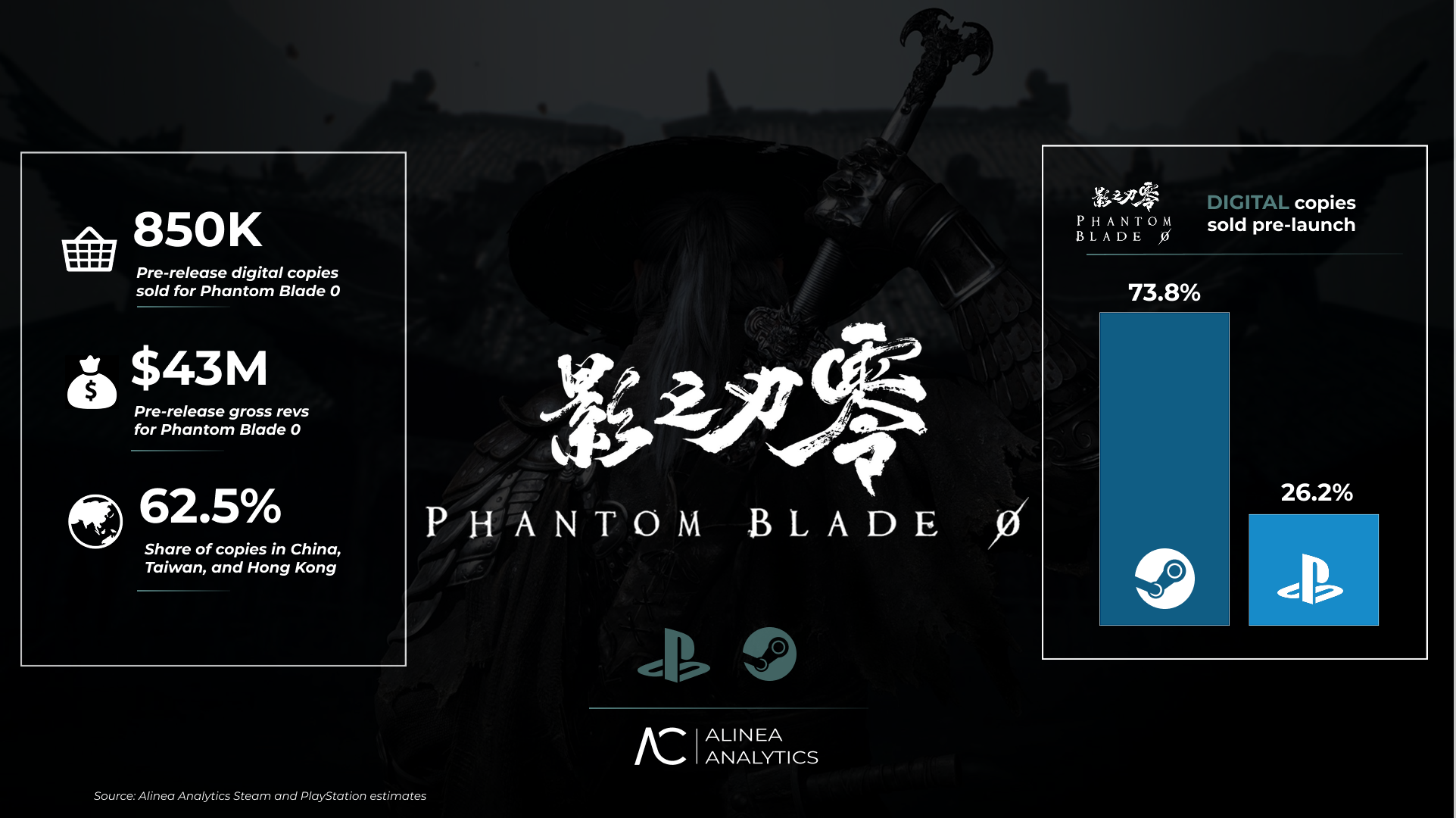
Now, Phantom Blade Zero has pre-sold 850K digital copies across Steam and PlayStation, with 73.8% on Steam and 26.2% on PS5. Here, it’s already generated $43M in revenue, with 69.2% via Steam and 30.8% via PS5 – slightly different shares due to regional pricing and the higher share of copies sold in lower-priced countries on Steam. More on that in a sec.
Phantom Blade Zero has also sold another 80K+ copies since the embargo lifted yesterday. It’s already a top 40 new 2026 game by revenue (across PlayStation, Steam, and Xbox), and it’s not even out yet or available for purchase on Xbox.
And this is only looking at Steam and PS5. A significant number of Phantom Blade Zero copies have doubtlessly been sold on Tencent WeGame (an online PC storefront in China) too. It’ll be WELL past 1M at this point.
But one country is very much leading the charge here.
China, Taiwan, and Hong Kong account for most of Phantom Blade Zero’s revenue
Overall, around 62.5% of Phantom Blade Zero’s pre-launch copies sold have been in China, Taiwan, or Hong Kong. These markets – but predominantly China – account for 75.9% of the copies on Steam and about 24.9% on PS5.
However, the regional pricing we mentioned earlier means that China, Taiwan, and Hong Kong account for 55.1% of Phantom Blade Zero revenue (versus 62.5% of copies).
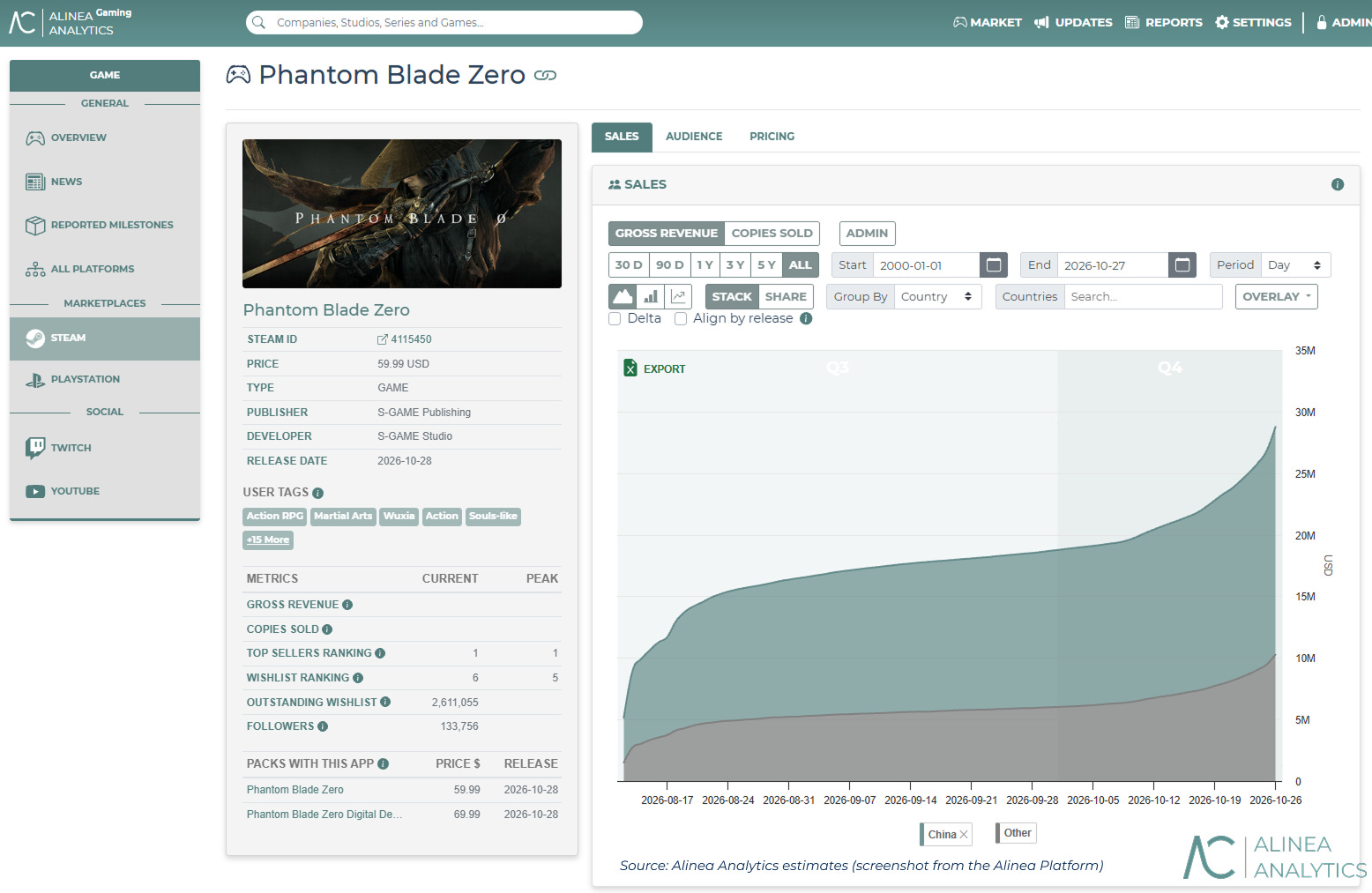
If we cherry-picked a handful of Western markets – let’s say the US, UK, Spain, France, Italy, and Germany – we’d be missing 84.4% of the game’s revenue on Steam and 58.7% on PlayStation. This shows how vital it is to look at all markets when using a market-intelligence platform to evaluate a game’s revenue.
As we do with all big releases here on the newsletter, we’ll be covering Phantom Blade Zero’s launch in an upcoming edition, so be sure to hit subscribe below to get that in your inbox when it’s ready.
From a China-made AAA game in a relatively unknown IP to a Japan-made pixelated one in a legendary franchise.
Final Fantasy Resonance finds early success
Final Fantasy Resonance, which launched on Oct 22, is a reimagining of the first story arc in the 2015 mobile game Final Fantasy Brave Exvius. It uses Square Enix’s lush HD-2D art style (combining pixel-art sprites with 3D environments), and it plays and feels like the classic pre-FFVII turn-based Final Fantasy games.
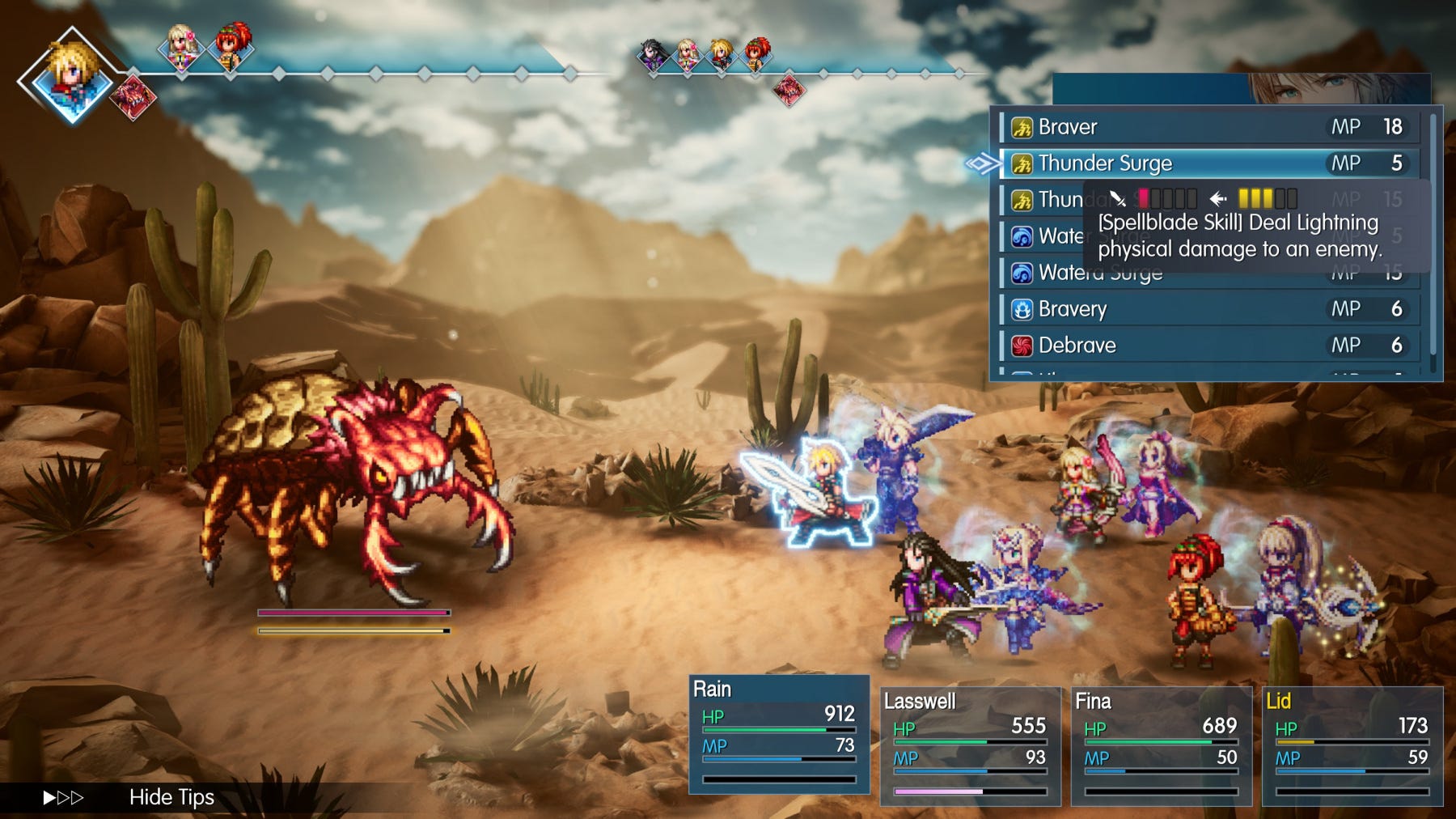
FF Resonance returns to the series’ roots while modern entries in the series – including the awesome FFVII remake trilogy – have focused more on action. So far, Resonance has been selling well – but mostly to one core group of gamers starved of Final Fantasy games of this ilk. Most of the players have previously played a Final Fantasy game, especially on PlayStation.
After less than five days since launch, Final Fantasy Resonance has sold through 400K copies (so no unsold retail copies!) across PS5 (48.8%) Steam (48.6%), and Xbox (2.6%).
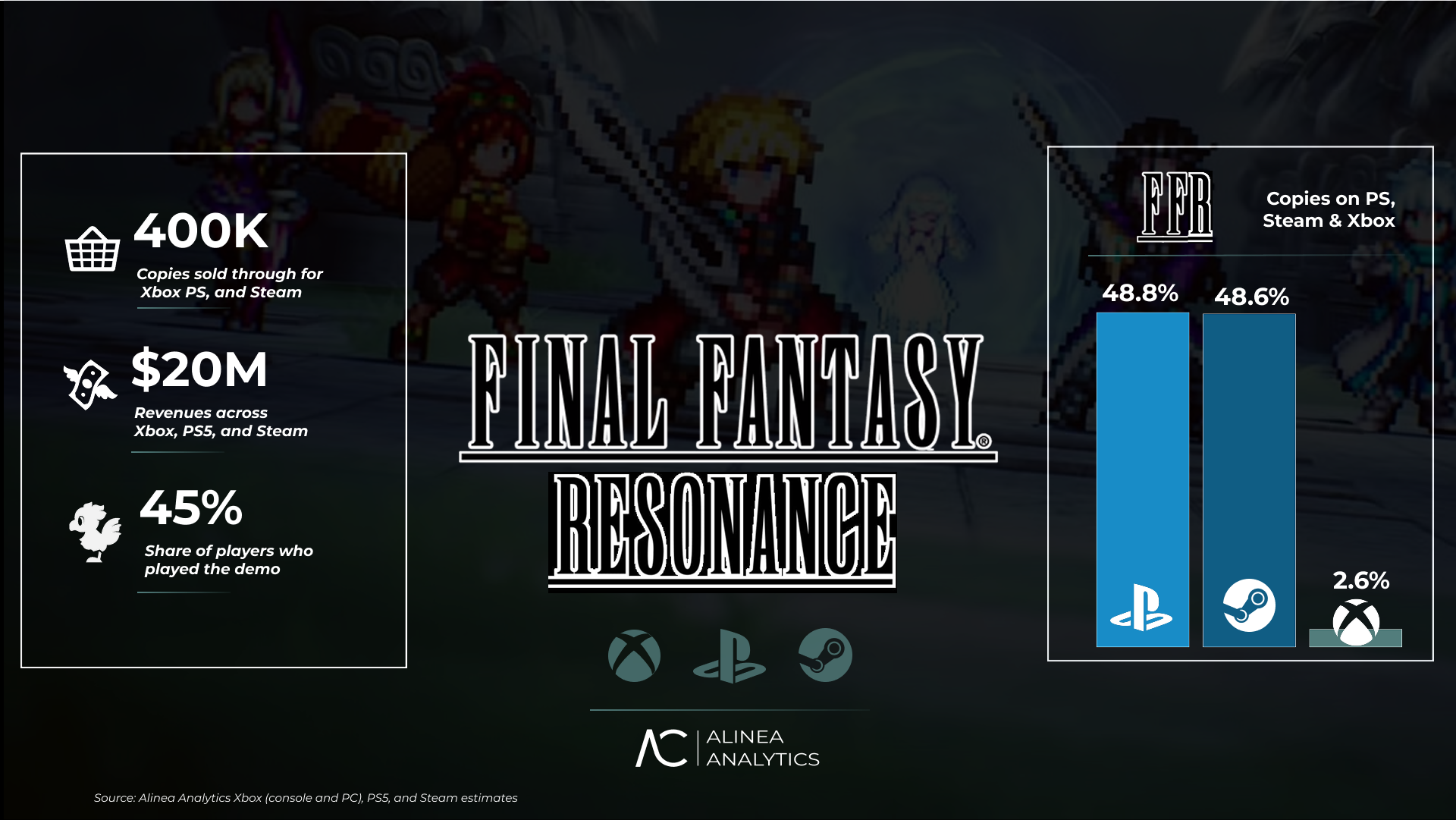
Final Fantasy Resonance has generated $20M in revenue, with 55.3% of that via PlayStation, 41.6% on Steam, and 3.1% on Xbox.
Players love this one almost unanimously (you could say it’s really ... resonating with them), which is sadly becoming rare in today’s fandom.
Anyway, Resonance’s user reviews are sitting at 4.8/5 on PlayStation and Xbox, and the positive Steam user score is a whopping 97%, with even Chinese-language reviews hitting 95% (!!!).
Our sentiment analysis shows that players consistently praise the return to classic turn-based combat, describing it as refreshing, strategic, and a love letter to the franchise’s roots.
I very much agree, and it’s making me very excited about the inevitable 2D-HD remake of my favourite game of all time, Chrono Trigger. I digress.
Did Square Enix bet on the wrong chocobo with Final Fantasy?
Given the strong positive reaction to – and early sales of – Resonance and last year’s Expedition 33 (which is tracking way better than recent Final Fantasy games), it seems clear that Square Enix has left a significant chunk of JRPG players behind during their move towards more action-oriented Final Fantasy titles.
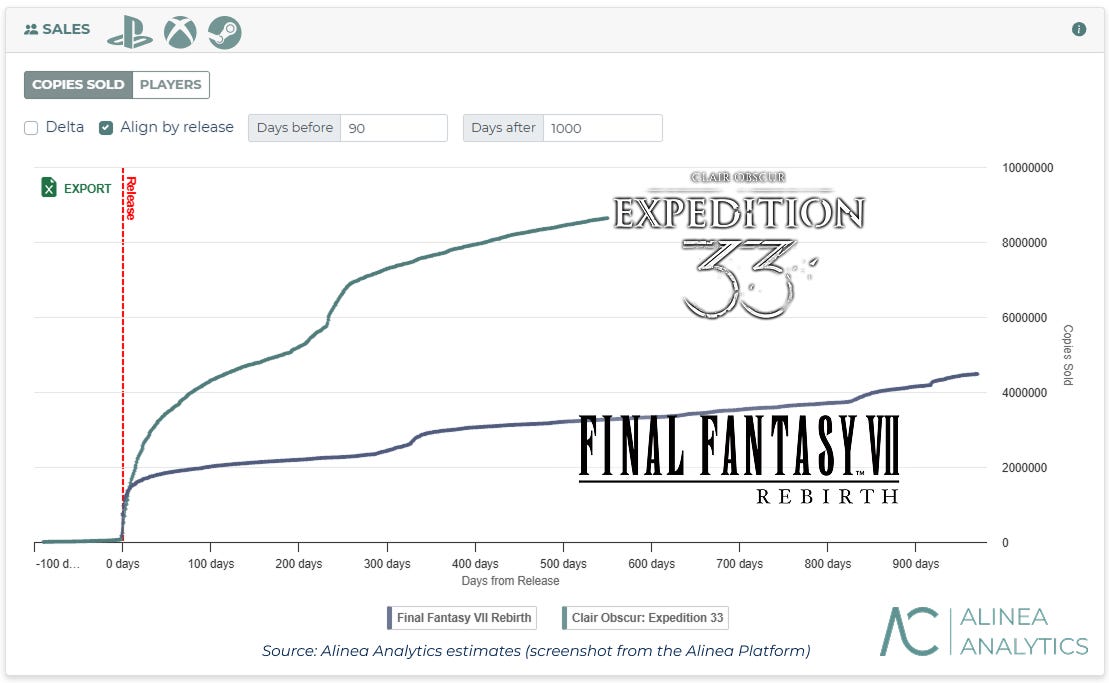
While Square chased more Western trends, a Western company swept in and released Expedition 33, a game JRPG fans wanted for decades and even won game of the year at The Game Awards. Square knows this, knows what it’s missed out on, and it’s seen Capcom succeed on Steam with its legacy franchises where Square Enix has arguably floundered.
So I can see Square Enix going down a new route, with many diverging paths, for Final Fantasy. They’ve already outlined their plans to go fully multiplatform, smartly moving away from timed PlayStation exclusivity.
I can also see the company balancing its MMO, high-fidelity remakes, and big-budget mainline Final Fantasy titles with more of these smaller 2D-HD original pixel games alongside the 2D-HD remakes.
There’s still a gap for a turn-based JRPG big-budget Final Fantasy, though, and all the signals are pointing Square Enix in that direction. Just a matter of time, I reckon.
And I’d take even more cues from Capcom, if I were them.
A strong demo helped things with Resonance
Square Enix knew what they were onto with Resonance, and the demo they released back on September 3 has gone down well. The Final Fantasy Resonance demo amassed over 650K players across PlayStation (342K demo players) and Steam (311K).
About a quarter of those demo players ended up buying the game. This is an excellent demo-to-purchase rate, as most demos convert in the low teens. What’s more, about 45% of Final Fantasy Resonance players had previously played the demo, and demo activity has spiked across platforms since the game dropped.
On Steam, around 100K players downloaded the Final Fantasy Resonance demo for the first time after the main game had launched.
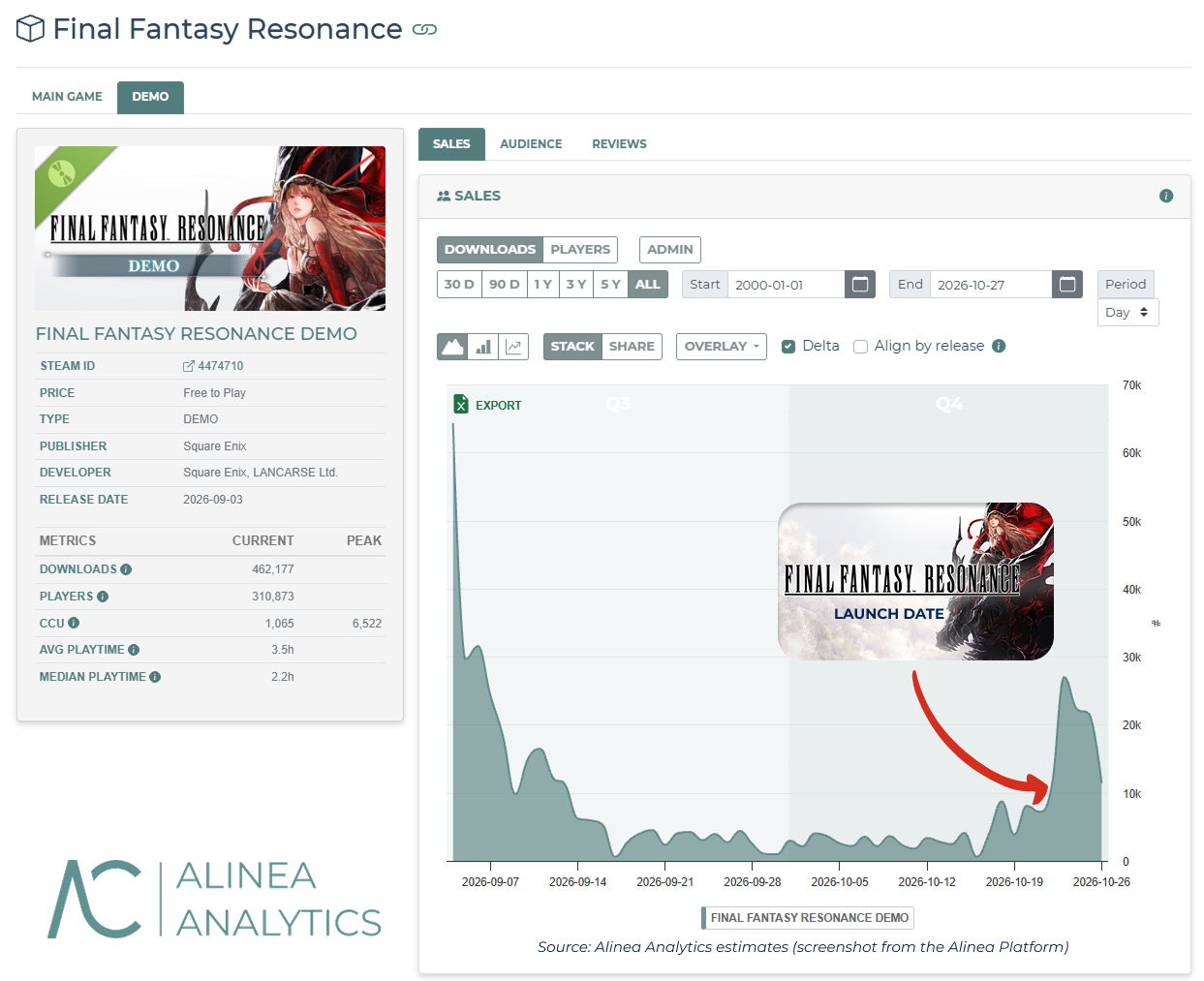
What’s more, 62.7K folks actually played the demo for the first time after the game had already released, even with Next Fest flooding the zone with other demos. Speaking of which…
Next Fest just had an ungodly amount of games showcased
Despite some recent in-the-right-direction changes to recommendations, Steam has always had a discoverability problem. There’s just too many bloody games, and the attention economy is already oversaturated.
And with the advent of generative AI, things are getting even weirder. There are now even more games constantly flowing onto Steam, including plenty of AI slop. This spells difficult news for Next Fest, which was already pushing it when it comes to the number of featured games.
While the recent edition had some banging demos, which our CEO covered over here, the sheer number of demos – and the amount of AI-generated demos – has been the talk of the town.
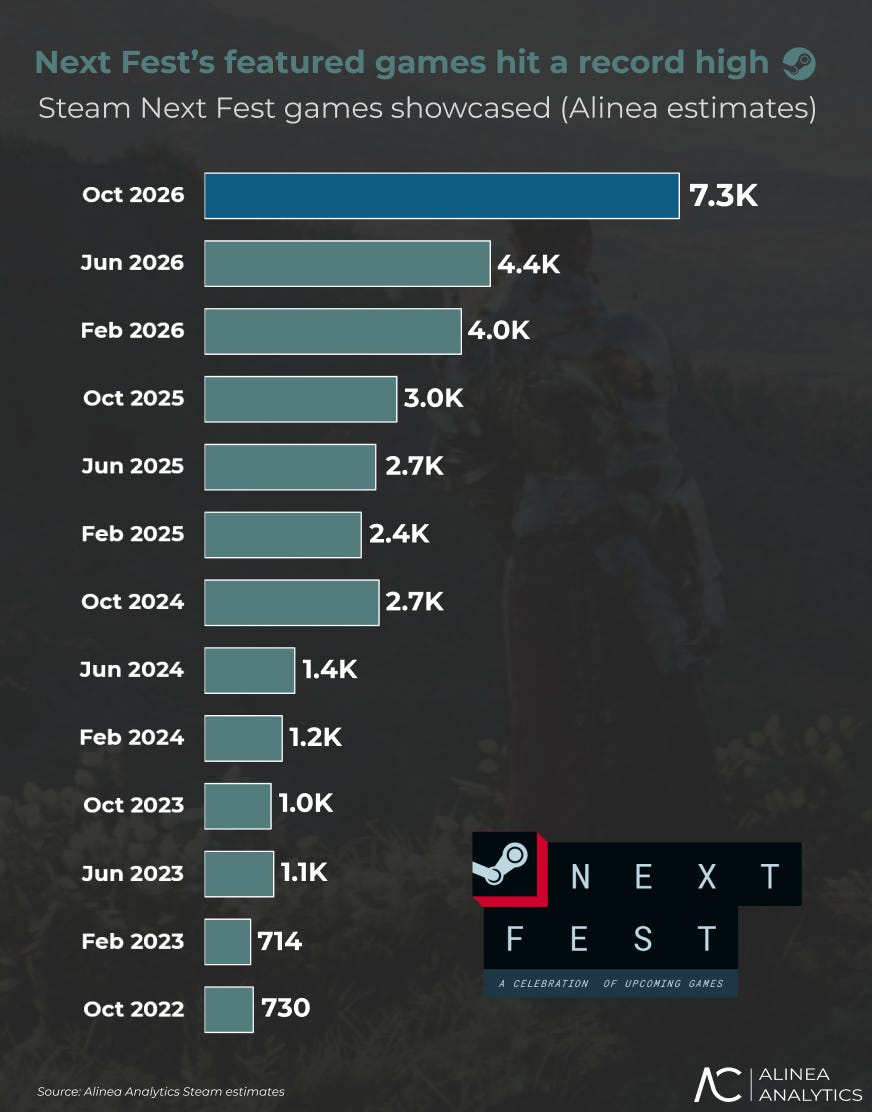
As you can see, October 2026’s Next Fest showcased 7.3K games, up 66% from the previous edition in June 2026 and more than twice the number from the October event last year. The number of demos has grown by 10X since the October 2022 edition.
Who else is pumped to check out 30K demos in October 2028’s Next Fest? Surely something’s got to give here.
Anyway, we’ll be covering Next Fest more deeply in our client-exclusive newsletter tomorrow. We’ve got demo player numbers, user reviews, CCUs, play time, and a lot more, so it’ll be a fun one. But we’ll give away some more data bits and bobs in this week’s spooky-themed second free newsletter, too.
Subscribe below to get that in your inbox when it’s ready later this week.
The last word
Reply to this email – or reach out here – if you have any feedback for the newsletter – or want to request a game for us to cover.
[Alinea Analytics boasts the most accurate PC and console estimates in the business. Game makers use our platform to understand their audience, keep an eye on the competition, monitor sales trends, and spot new opportunities. We equip game studios and financial institutions with accurate data and the confidence to make smarter, data-driven decisions. Want to talk about all things games market data? We’d love to chat!]