

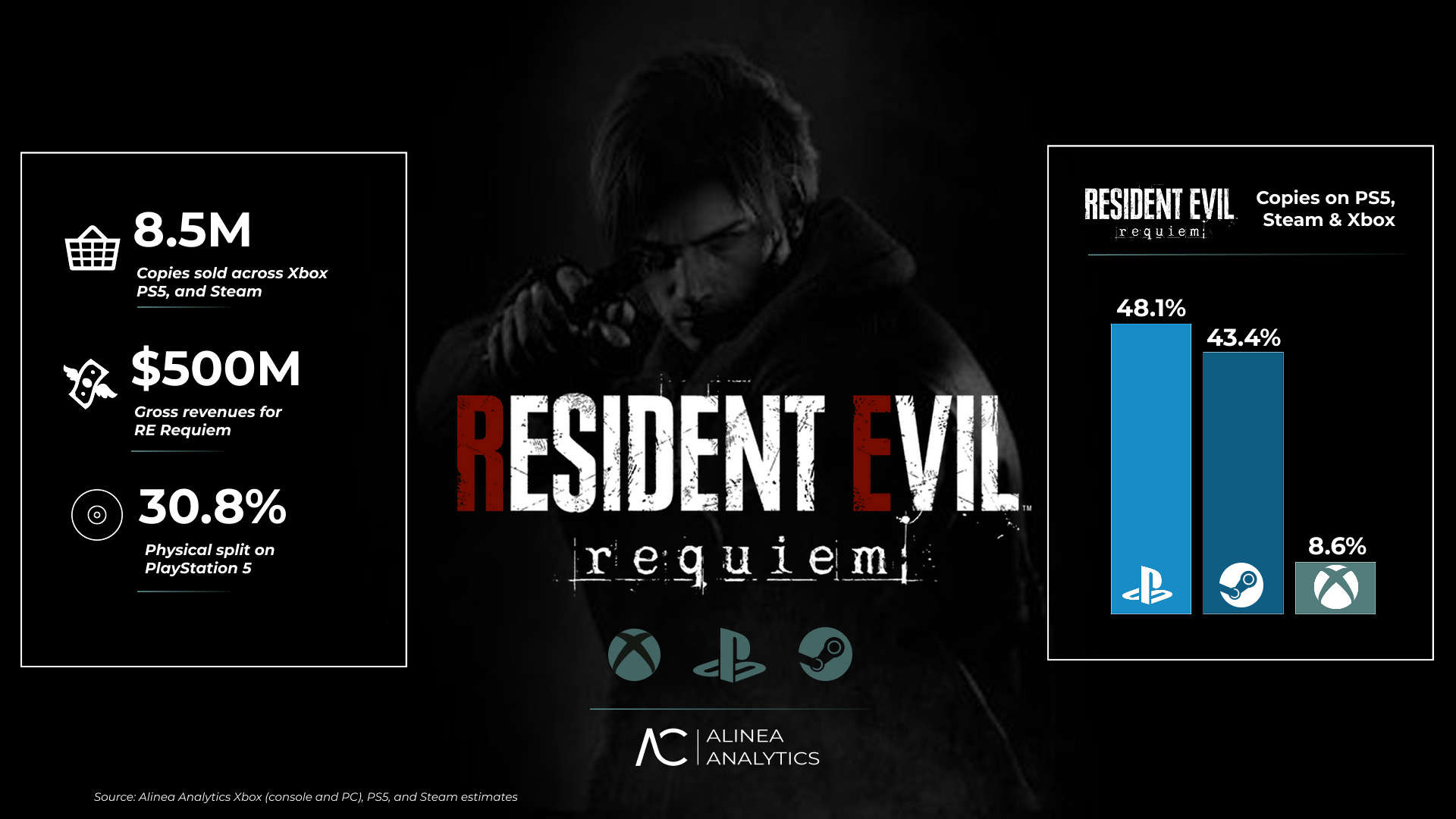
Resident Evil Requiem, which launched at the end of February, is a behemoth. It’s just passed $500M. Revenue-wise, it’s outpacing every other game in the franchise and will certainly leapfrog the Resident Evil 4 remake’s $600M+ when all is said and done.
Requiem is also another hit in Capcom’s greatest run of its 46-year history, having sold a record number of games last fiscal year and openly targeting even more this year. Part of that success is Capcom’s strategy around catalogue sales and discounting on Steam.
But PlayStation remains Requiem‘s #1 platform, accounting for 48.1% of the 8.5M players (followed by Steam with 43.4%). Of the more than 4M Requiem copies on PS5, 30.8% (or 1.2M) are physical.
In the movie world, Zach Cregger (Weapons, Barbarian) directed the new Resident Evil reboot. It’s a critical and commercial smash, opening to $108.3M worldwide, the biggest opening in the 24-year history of Resi films and the highest-rated horror film of the year at 96% on Rotten Tomatoes.
Sony’s own PlayStation Productions co-produced the movie, so Sony had every incentive to turn cinema tickets into game sales.
Cregger’s rendition is only loosely based on the games, though, following a medical courier chaotically traversing the Raccoon City outbreak. But it’s mostly just easter eggs for us game fans. It doesn’t follow any of the game protagonists and takes plenty of lore liberties.
I consider myself a pretty big Resi fan, and I absolutely adored this movie. It really captures the feeling of playing a survival horror game, and it was fun to spot the references. And like Barbarian and Weapons, it’s just a bloody fantastic horror movie with the right mix of dread, grossness, and humour.
So with this in mind, how – if at all – has Cregger’s Resident Evil movie impacted game sales? Let’s start with engagement, daily active users (DAUs).
Engagement went up across the Resident Evil catalogue
In the week after the movie’s release (Sep 18 onward), DAUs increased across every Resident Evil game we track. For example:
Resident Evil 2‘s remake jumped +48% (from ~78K to ~116K daily players). RE2 is set in Raccoon City during the outbreak, has a huge installed base, and has had some huge discounts (more on that later).
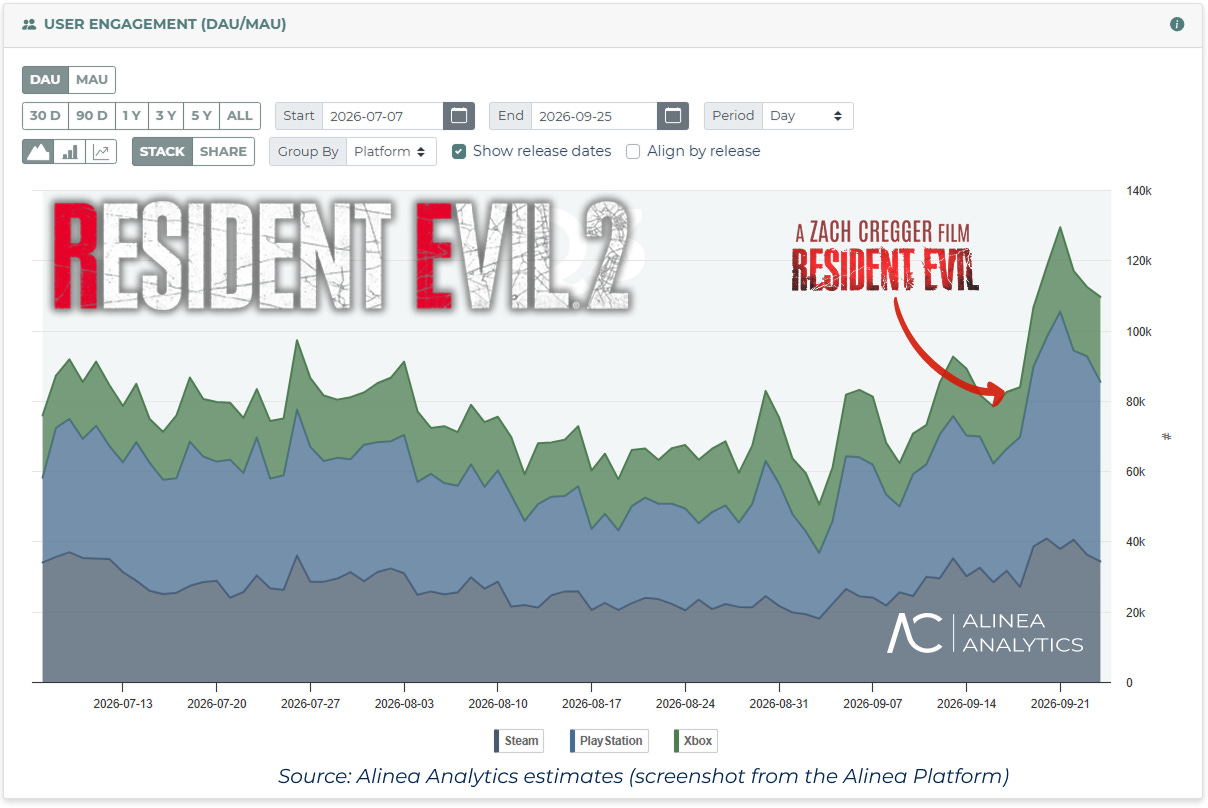
Resident Evil 4 remake is up +24% (from ~199K to ~247K). The smaller percentage hides the biggest absolute jump, much of which came from $10 fire sales on Steam.
Resident Evil 3 remake jumped +25% (from ~28K to ~35K). Despite being set in Raccoon City, this remake has been the worst-received of Resident Evil’s recent success run.
Resident Evil Requiem jumped +20% (from ~118K to ~143K), the newest game getting a natural top-up.
So engagement is up, but what about revenue and copies?
Discounts did most of the work, but the movie has contributed
With transmedia stuff, game discounts always land at the same time as the movie or show, including The Last of Us, Fallout, and Spider-Man. When copies spike, this makes it bloody tough to figure out whether people bought because of the transmedia or the price. It’s mostly the latter, but everyone credits the shiny new movie.
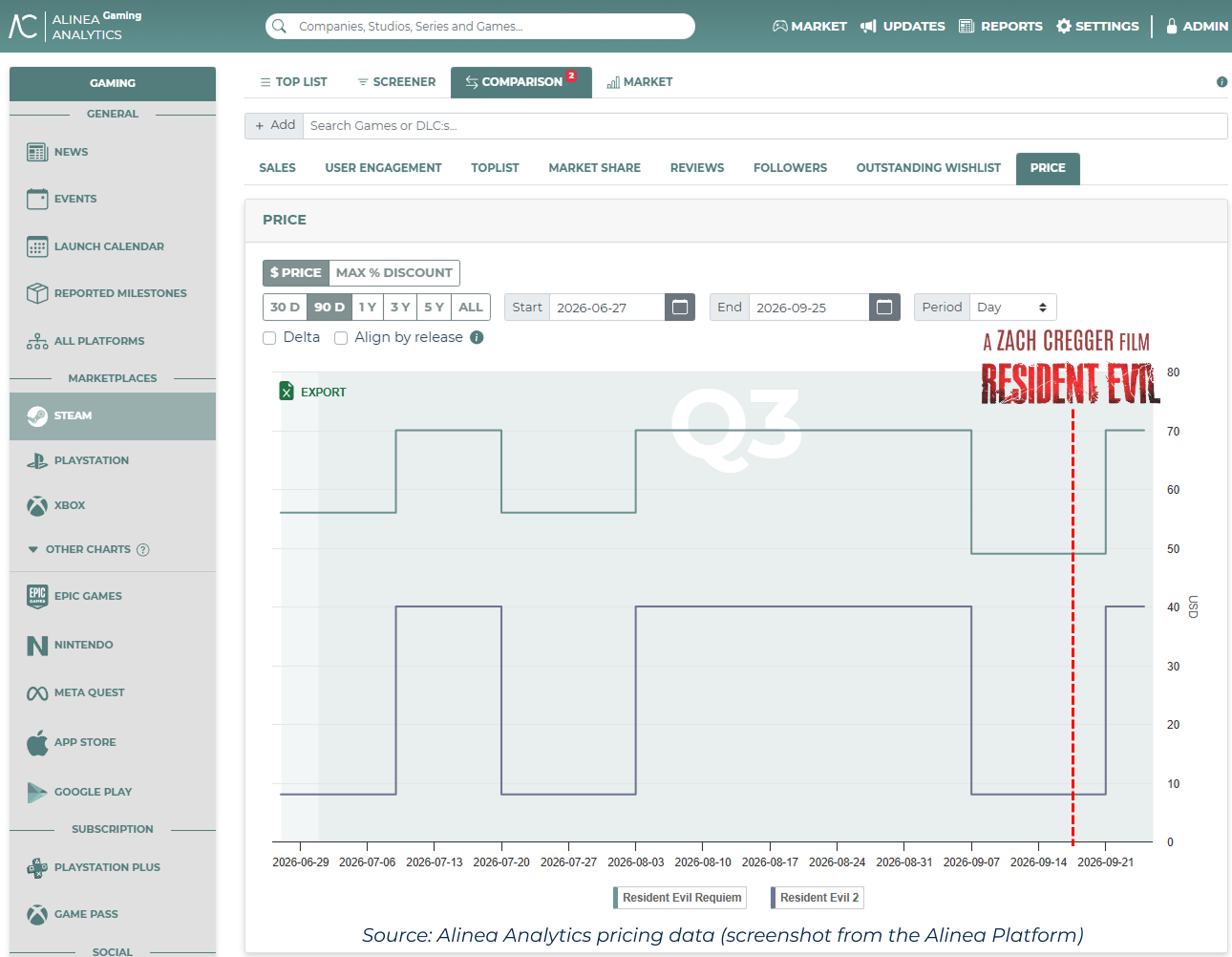
Resident Evil gives us a fun case, though. Capcom started knifing its game prices on Sep 10, eight days before the film hit cinemas. This gives us a “discount, no movie” window (Sep 10 to 17) and a “discount plus movie” window (Sep 19 to 24) at the same price. You can see an example of these price drops on Steam in the platform screenshot below:
So, if we hold the price constant across those two windows (and take prior discounts’ impact into account), whatever’s left over is the movie. As the price cut predates the film, any lift in that first window is baseline discount behaviour, so we’re measuring the movie against Resi’s own discount, not against full price.
First, here’s what happened to copies, revenue, and price on each platform in the week after release versus the two weeks before:
Almost all the copy movement was on PlayStation. RE2 nearly doubled on PS5 while doing just +16% on Steam, and RE4 jumped +77% on PS5 versus a flat 0% on Steam. Those healthy-looking Steam revenue lines are interesting too, as Steam flipped its prices back to full on Sep 21, booking more dollars on fewer copies.
Now the disentangling. Before the film was in cinemas, the discount on its own was doing the lifting. On PS5, dropping the price roughly doubled daily copies (RE2 about 1.9x from $39.99 to $7.99, RE4 about 1.9x from $39.99 to $9.99, Requiem about 1.8x from $69.99 to $48.99). That is the big lever, and Capcom pulled it first.
When we filter out the price, the movie’s contribution alone looks like this:
RE2 and RE4 picked up another 50-65% in PS5 copies even after you strip the discount out, which makes sense: they have a mix of nostalgia, quality, and the exact Raccoon City setting the film runs around in. On Steam, the same movie effect is a much milder +11% to +14%.
But every one of those movie-driven copies sold for pocket change. RE2 shifted at about $8 to $9, RE4 at roughly $10 to $13. So yes, RE2‘s PS5 revenue jumped 80% and RE4‘s 84%, but off a firesale base.
I’ll be candid (crazy, I know!): this is slightly-boosted bargain-bin volume, not a demand surge at full price. The movie nudged a chunk of folks toward games that were already 75-80% off.
Requiem is the newest Resi game and the only one selling anywhere near full price, and the movie barely changed things. PS5 is Requiem‘s number-one platform, and during a record-breaking $108M movie weekend, PS5 Requiem revenue went down 4% (from about $284K to $271K a day).
So it sold more copies but for less money, because the only thing that properly shifted Requiem was its discount, and a discount by definition lowers what you make per sale. The Steam side crept up +14% in dollars, but only because the price went back to $70.
Capcom is a company that’s turned catalogue discounting into an art form, squeezing its back catalogue for hundreds of millions with perfectly-timed sales. Capcom systematically lowers entry barriers over time to capture every tier of consumer willingness-to-pay (and loosens buyers’ wallets for upcoming games.
It doesn’t need a film to convert to full-price purchases, the discount engine already does that job. The movie is just free top-of-funnel warmth stacked on top of a machine that was already humming.
So yeah, the engagement halo is there for sure, and lots of folks came back to play, but the revenue story is a discounting one. The movie’s contribution is small, low-value, and concentrated in games that were already doing catalogue goodness in the bargain bin.
Yes, Capcom earned a bit more in that window, but it did so mostly by selling cheap copies of old games, not by turning a blockbuster opening weekend into full-price Resident Evil sales. Again, there’s so much potential in transmedia. But we need to go a bit further here, and the story isn’t quite over yet.
What’s going on here?
Engagement across the catalogue jumped (people reinstalling and replaying games they already own), while new sales barely moved once we account for discounts. So Cregger’s movie reactivated the existing fanbase more than acquiring a new one.
I reckon there’s a few reasons for this:
In Cregger’s movie, there’s no character or story to chase back into a game, despite the movie having plenty of easter eggs for fans. Cregger deliberately crafted an original story around a new lead (to great effect), so there’s nowhere obvious for a curious newcomer to land.
The film audience already is the games audience. I spent about a year in cross-entertainment consumer insights before crawling back to games, and I remember the horror-film crowd and the horror-game crowd being about as overlapping as two circles get. So the film mostly preached to the converted.
Cregger is hot right now. After proving himself with Barbarian and last year’s Weapons ($270M worldwide), Cregger is a draw in his own right.
Amazon’s Fallout similarly nailed the world and tone, but that world is more of a unique one and funnelled viewers into a deep catalogue of Fallout they could jump right into.
HBO’s The Last of Us (the first season, anyway) sent people to the games because it was a faithful, beat-for-beat retelling, and fans wanted to see the next chapter. The Super Mario Bros. Movie and the Spider-Man films work the same way, but accelerate for kids. The common thread is a named protagonist you can go and be.
Resident Evil borrowed the world and the vibe but didn’t have a similar onramp. It’s my fave film of the year so far and a brilliant advert for the brand, just not a storefront for any particular game.
So the movie helps Resi keep culturally warm heading into whatever’s next: next year’s Resident Evil Veronica, the remake of 2000’s Code: Veronica and the first full-blown Resi remake since RE4 in 2023. It’s already sitting on almost 2M wishlists on Steam alone.
The synergy potential is juicy, too.. Veronica stars Claire Redfield, a face casual fans will recognise. And if it follows the original timeline, Veronica takes place three months after the Raccoon City incident, the event the film is built around.
So there’s a narrative bridge between the movie and the next game, which is more than this reboot offered any existing title. Get the streaming release timed around Veronica‘s launch, put a recognisable character at the centre of both, and Capcom (and Sony) might finally build the on-ramp this transmedia experience – and every bloody other one – was missing.
It’ll happen eventually, surely.

Cool links and other stuff
It’s been another busy press week! Our Star Wars Zero Company data was covered by Eurogamer, IGN, Kotaku, GameSpot, and a bunch of others.
We also chatted to Kotaku about Xbox’s recent layoffs and studio restructures.
We’re offering a free trial of our platform for games companies. Send us a message here, or reply right here on Substack/email, and we’ll set you up.
The last word
Reply to this email – or reach out here – if you have any feedback for the newsletter – or want to request a game for us to cover.
[Alinea Analytics boasts the most accurate PC and console estimates in the business. Game makers use our platform to understand their audience, keep an eye on the competition, monitor sales trends, and spot new opportunities. We equip game studios and financial institutions with accurate data and the confidence to make smarter, data-driven decisions. Want to talk about all things games market data? We’d love to chat!]
Numbers sound great! But where is the Switch 2 version in the split? Surely it sold more than 0%.