

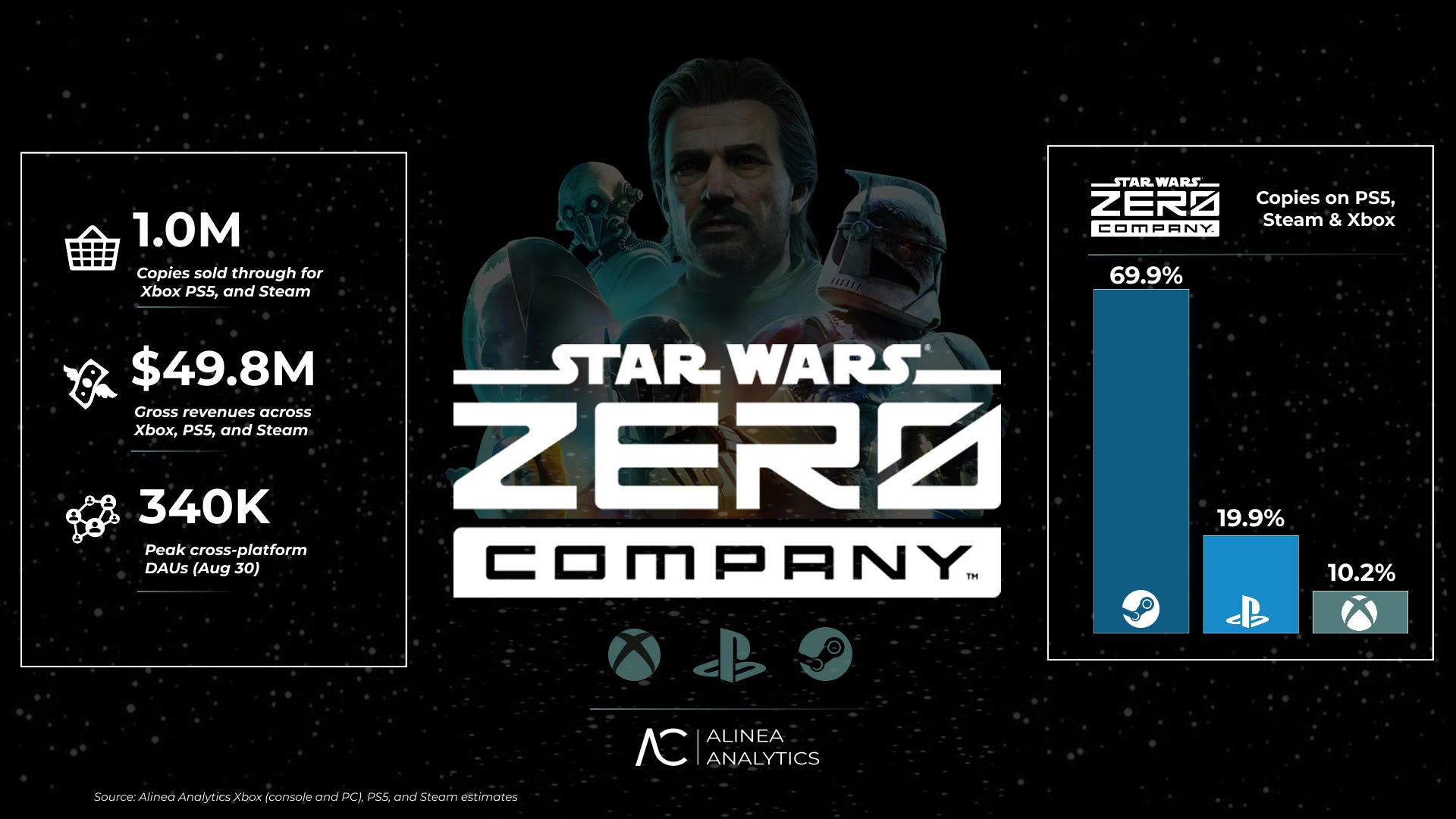
Star Wars Zero Company has passed a million sold-through across Steam (69.9%), PlayStation (19.9%), and Xbox (10.2%, including Xbox PC). Zero Company is a single-player, turn-based tactical game set during the final days of Star Wars’ Clone Wars.
Quality-wise, and in my humble opinion, Zero Company is one of the best pieces of Star Wars media in ages, barring Andor and perhaps Jedi Survivor. Zero Company landed an 86 on Metacritic, the highest score of a Star Wars game in 22 years (since Knights of the Old Republic II – banger – in 2004), sitting above Jedi Survivor, Fallen Order, and Outlaws.
Zero Company was developed by Bit Reactor, a team made up of Firaxis veterans, including co-founder Greg Foertsch, who worked on franchises like XCOM and Civilization. For Zero Company, Bit Reactor got support from Respawn and publishing from EA. In other words: XCOM people made an XCOM-style Star Wars game. It’s rad, but it’s niche.
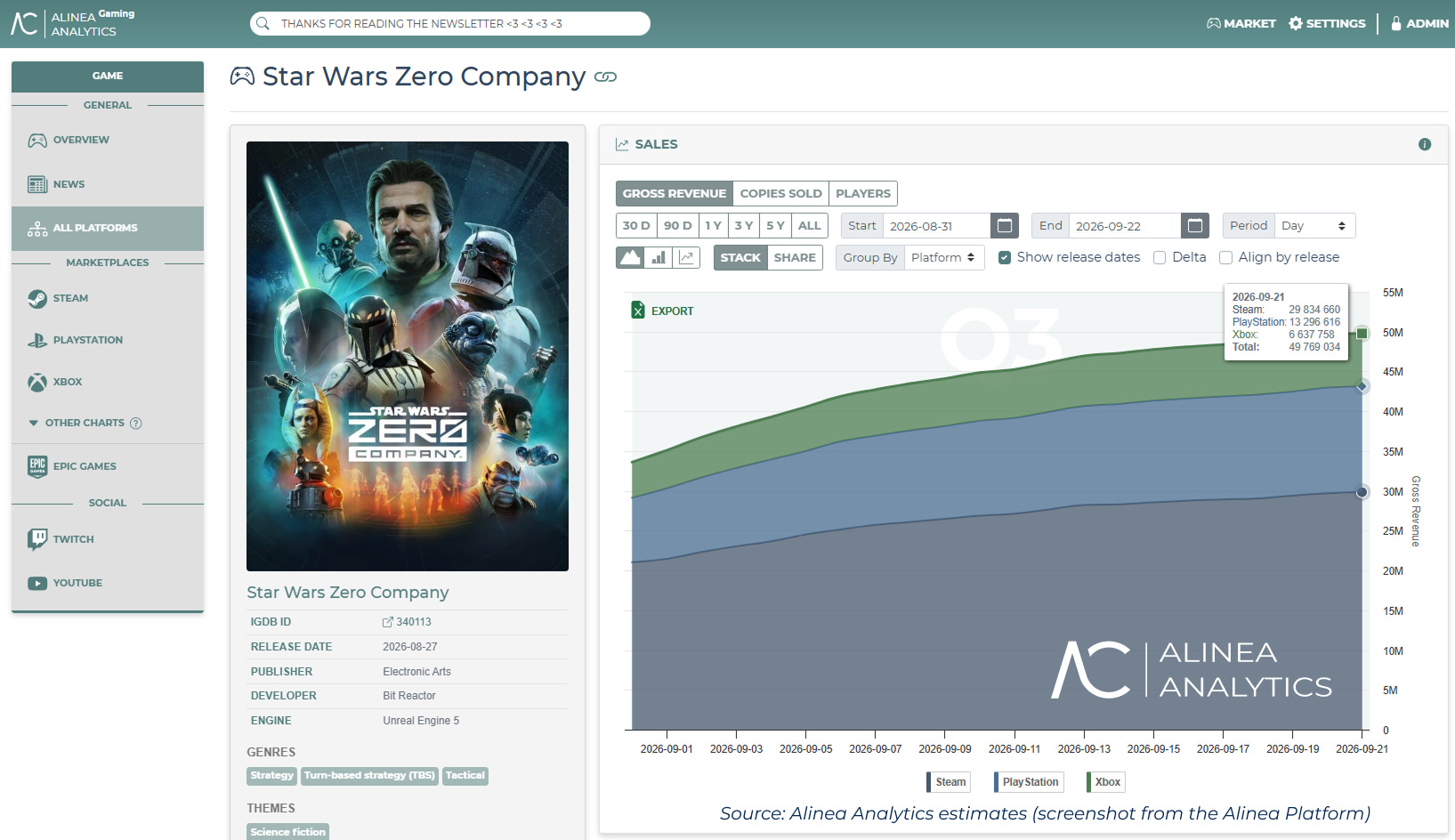
Around $50M in revenue for Zero Company so far
Zero Company has made about $50M since launching on August 27, respectable for this genre and during such a crowded period (even with the Star Wars brand attached).
While console makes up 30.1% of the copies sold (19.9% for PS5 and 10.2% for Xbox), regional pricing differences mean console accounts for 40.1% of the revenue (26.7% on PS5 and 13.3% on Xbox). Console players pay more per copy, so – relatively speaking – they bring more revenue.
One thing limiting Zero Company’s sales, as with many Star Wars games, is that it’s only really popular in the West. Of Zero Company’s players, 90% are in North America or Europe, with under 5% in Asia.
On Steam, the Chinese user reviews sit at 57% positive (versus an 82% global average), with many pointing to the lack of VO and localisation options. Star Wars has never had the pull in Asia that it has in the West, of course. But skipping proper localisation compounds that.
Given Bit Reactor’s history in the genre, it’s no surprise that a chunk of Zero Company players have engaged with XCOM in the past.
On Steam, 28% of Zero Company players had previously played XCOM 2
And 6% played XCOM: Enemy Unknown on Steam.
On PlayStation and Xbox, 32% had previously played XCOM 2
Star Wars fans showed up in full … force, too. On Steam, 32% played Star Wars: The Old Republic, 24% played Battlefront 2, and 24% played Fallen Order.
On console, the Star Wars fandom is doing more of the heavy lifting, relatively speaking, as the XCOM franchise – and turn-based strategy games in general – are simply less popular there. According to our estimates:
63% of Zero Company players on PlayStation have also played Jedi Fallen Order (85% on Xbox)
55% have played Jedi Survivor (68% on Xbox)
40% played Star Wars Outlaws (45% on Xbox). The Xbox shares run higher thanks to EA Play access via Game Pass Ultimate and PC.
Despite making something this rad, most of the team behind Zero Company was sadly furloughed in the weeks before launch. Reportedly, the studio had run out of most of its cash before its debut even shipped (Bit Reactor says the call was its own, not EA’s or Disney’s).
Either way, much of the team that built this bloody GREAT game, the best-reviewed Star Wars one in more than two decades, was sitting at home unpaid at launch. That absolutely sucks.
I sincerely hope the game makes enough to bring the team back on full pay. They’ve made something fantastic here, and they deserve to see it through.
2026 games based on non-game IP are closing in on $1B in revenue this year
There’ve been quite a few games this year based on non-game IP, and together they’ve made over $900M in revenue, as per our estimates.
The top 20 this year is made up of all kinds of IP, everything from 007, Marvel, and LEGO Batman to Jay and Silent Bob and Starship Troopers. The top five are as follows (OK, top six, because the bottom was so tight):
007 First Light has generated $309.8M, with $200.6M via PS5 (64.6%), $70.0M via Steam (22.8%), and $39.2M via Xbox (12.6%). First Light recently passed 4.5M copies sold, making it one of the most successful new games of the year, shifting 2.8M copies on PS5 alone. Of those playing First Light on PS5 this month (about 88K folks), 11.3% have also played Wolverine this month, while 2% played this year’s Lego Batman. Those are 007‘s top games by unique-player overlap this month. Speaking of which…
Lego Batman: Legacy of the Dark Knight has now batarang-ed 2.3M copies sold and passed $165M in gross revenue. PlayStation alone accounts for $100M of that, about 60%. On PlayStation, the kid-friendly audience is here in full force: 78% of Lego Batman’s players have played Fortnite, 76% have played GTA 5 (lol, which 12-year-old isn’t playing?), 78% have played Spider-Man, 70% Spider-Man 2, 68% Miles Morales, and 64% Minecraft. Our data also shows Lego Batman offered a free trial for PlayStation Plus Premium members a few months back. Over 100K folks tried it, and 3.1% converted to buyers.
Wolverine has now generated almost $150M on PS5 since launching exactly a week ago. We covered Wolverine here, so check that out for more. A few people were upset that we compared Wolverine‘s launch to Death Stranding 2 last week. But we also compared it to every PlayStation Studios game from the past three years and every new PS5 game this year. Plus, Death Stranding 2 was the closest PS Studios comparison point ($129M on PS5 versus Wolverine‘s then-$130M), and Kojima and PlayStation had just divorced. So yeah, sticking to our claws on that one.
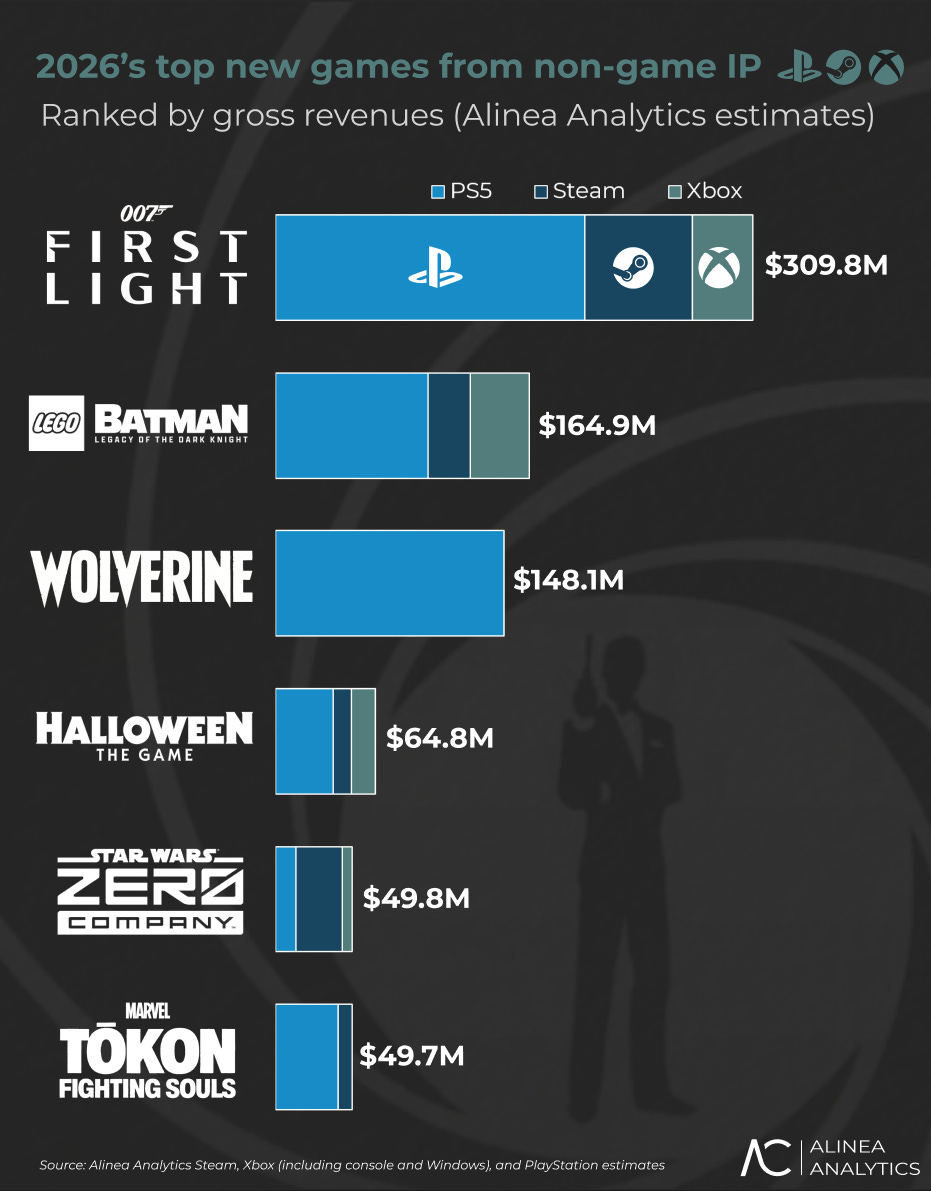
Halloween: The Game has now made about $65M via 1.5M copies sold since launching two weeks ago. It’s an asymmetrical 1-vs-4 survival horror game, so slashed from the same cloth as Dead by Daylight, as well as IllFonic’s own 2017 Friday the 13th game. There’s also a standalone six-mission story mode that lets players relive the events of the 1978 Halloween film through the eyes (and mask) of Michael Myers. Its success is a testament to horror fandom, how well horror concepts translate to games, and the overlap between horror fans and gamers. Next up, Hellraiser.
Star Wars Zero Company, which … yeah, scroll up. Or swipe up if you’re on mobile or have claws (or have a lightsabre).
Marvel Tokon has generated almost $50M via its 750K copies sold across PlayStation (about 82%) and Steam (about 18%). While Tokon peaked at around 300K DAUs during launch, its cross-platform DAU number has since dropped below 40K. Weekly copies sold have fallen drastically too, at under 15K last week. That said, $50M and 750K copies in a niche genre is still a decent result. While the PS5 version fared well, the PC version’s problems (technical, account, and DRM) have severely limited Tōkon’s momentum.
Not all non-game IP (and genre adaptations) is equal; let’s act like it
The success of the Batman: Arkham games, Marvel’s Spider-Man games, and the silly success of Hogwarts Legacy makes it tempting to assume every quality transmedia project will be a monster. It won’t.
Those are outliers, and they shouldn’t set the baseline. There’s only room for a finite number of those mega games, so treating these insane hits as the expectation is how you end up disappointed by a game that sold a million copies.
007 First Light alone accounts for over a third of the $900M+ that non-game-IP generated this year ($309.8M), and the top three take the vast majority. But the more realistic (and, I’d argue, more interesting) opportunity for many non-game IP is the middle. So that’s those experiences like Zero Company, Marvel Tokon, and the imminent Star Wars: Galactic Racer.
These aren’t billion-dollar makers like the very singular Spider-Man games, nowhere near, but they don’t need to be. $50M for a turn-based tactics game or team-based fighting game in a stacked release window is a decent result, especially if it ties to a larger brand goal.
These so-called transmedia games can help new studios secure projects, hand creatively bankrupt film and TV rights-holders a rev-share lifeline, and add quality to brands some had written off (something to get the fandom pumped about). Zero Company‘s story is better than every recent Star Wars thing not named Andor, and that counts for something for a brand that has had miss after miss, quality-wise.
So no, games based on non-game IP are not all billion-dollar makers, but let’s not throw the baby out with the bathwater. Just as film and TV have their more niche media prestige things alongside the tentpoles (Lanterns next to Superman, The Penguin next to Batman), games will have their AA and more niche tiers too.
The money’s real, the brand equity’s about, and the appetite is there ($900M and counting this year). It seems like we just need to recalibrate what success looks like, projections- wise (and also budgets-wise, to be fair).
What I’m saying here is that not all non-game IP – and how they’re adapted – is equal. Blockbusters designed for broad-market scale and focused AA/genre titles are beasts, make no mistake. It’d be banging if every transmedia thing were a Hogwarts Legacy, don’t get me wrong.
But in some cases, these things can be high-margin mid-tier releases that also help de-risk development portfolios while keeping legacy IP culturally active. Of course, it’d be abso-bloody-lutely great if a TV/movie release in a given IP could directly hit around a game in that IP (and vice-versa).
But production timelines are so nebulous – especially in gaming – that it’s just too bloody hard to execute. I’m sure someone will get there in the end though, and it’ll probably be Nintendo.

Cool links and other stuff
We’re offering a free trial of our platform for games companies. Send us a message here, or reply right here on Substack/email, and we’ll set you up.
It’s been another busy press week. Our Wolverine newsletter from last week was picked up by IGN, Eurogamer, Kotaku, Wccftech, and a bunch of others.
Our Head of Business Development, the awesome Tobias Sjögren, is at DICE Europe RIGHT NOW! So if you’re about, shoot Tobias an email at ts@alineaanalytics.no!
The last word
Reply to this email – or reach out here – if you have any feedback for the newsletter – or want to request a game for us to cover.
[Alinea Analytics boasts the most accurate PC and console estimates in the business. Game makers use our platform to understand their audience, keep an eye on the competition, monitor sales trends, and spot new opportunities. We equip game studios and financial institutions with accurate data and the confidence to make smarter, data-driven decisions. Want to talk about all things games market data? We’d love to chat!]