
Steam is having another record year for revenue
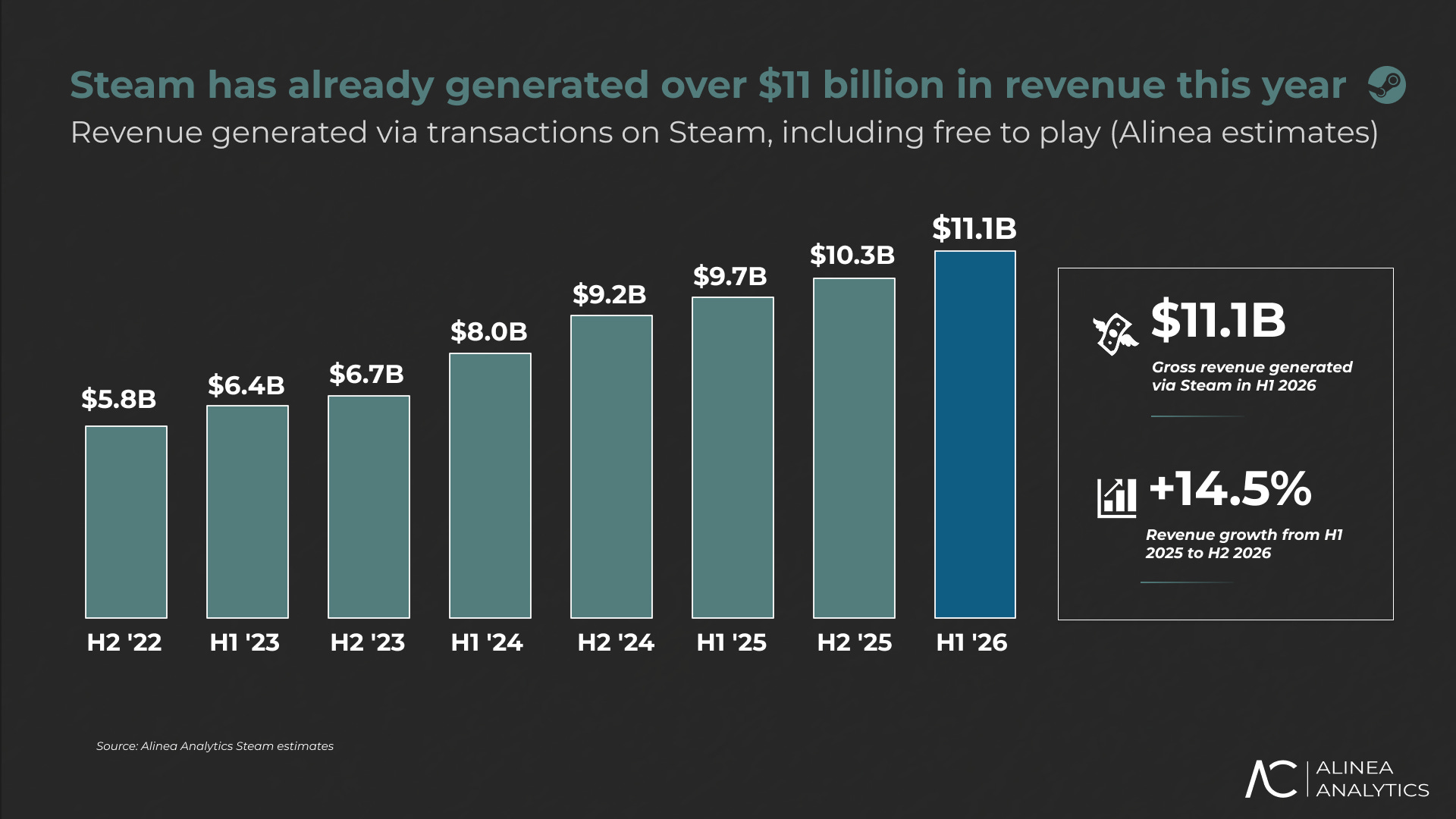
Steam has generated $11B in the first half of 2026 alone, the platform’s biggest-ever six months, as per our estimates. Here’s the numbers and some of the games driving them.

In the first half of 2026, we estimate that games on Steam generated $11.1B in gross revenue, the platform’s highest-ever half-year. That’s up 14.5% on H1 2025, and up 8% even on the holiday-heavy H2 2025, which is the more remarkable comparison given the back half of the year usually wins on seasonal sales and holiday buys.
Steam keeps finding growth, and the recent fuel has come from a few clear places:
The surge in Asian players (China especially)
Higher prices on new releases
Viral co-op hits
Smarter back-catalogue strategies from the big publishers
Third-party publishers quietly returning to Steam after their own-launcher experiments, tails between legs.
Steam’s 10-year growth trajectory is WILD
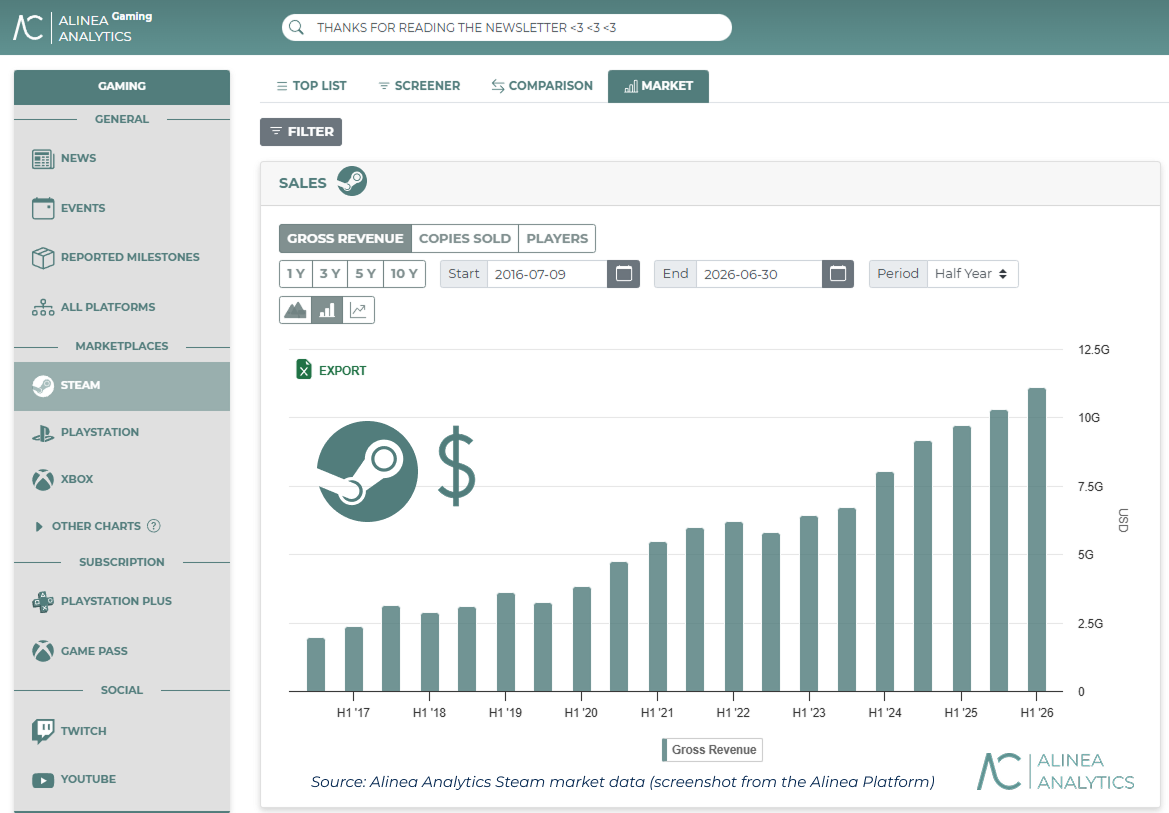
Zoom out over the last decade and things get really crazy. There’s obviously a visible dip as the market normalised after the pandemic sugar-high, but the long arc is relentlessly up, with seven half-years of growth:
Some takeaways:
H1 2026 is 4.7x larger than H1 2017, so Steam has roughly quintupled its half-year revenue in ten years.
Steam’s full-year revenue has climbed from around $5.5B in 2017 to roughly $20B in 2025.
Steam did more in the first six months of 2026 than in all of 2020, a year when the entire world was locked indoors and buying games to cope, and nearly matched 2021.
More Steam revenue is coming from back catalogue sales
Another trend worth watching, though, is the one with chunky implications for anyone shipping a game, especially in AAA. There’s a shrinking share of revenue coming from new games (games releasing in a given year):
H1 2024: 29% of revenue came from 2024 releases.
H1 2025: 27% came from 2025 releases.
H1 2026: just 21% has come from 2026 releases.
In other words, back catalogue revenue has climbed from 71% to 79%. Obviously, release calendars matter here, but we’ve long covered the fact that publishers are getting savvier with their back catalogues (discounts, bundles, timed sales).
And the sheer volume of releases keeps accumulating, and every new game increasingly competes not with this year’s rivals but with a decade of proven hits available at a fraction of the price.
Adding fuel to the fire for AAA is the diminishing graphical returns (a 2021 game looks close enough to a 2026 one for most players) and the hardware crisis. So that pull toward the back catalogue only strengthens for these sorts of experiences.
We’ve tracked the same dynamic on PlayStation and inside Capcom’s remake “flywheel”, with the catalogue becoming the business, and the new release becoming the marketing for it.
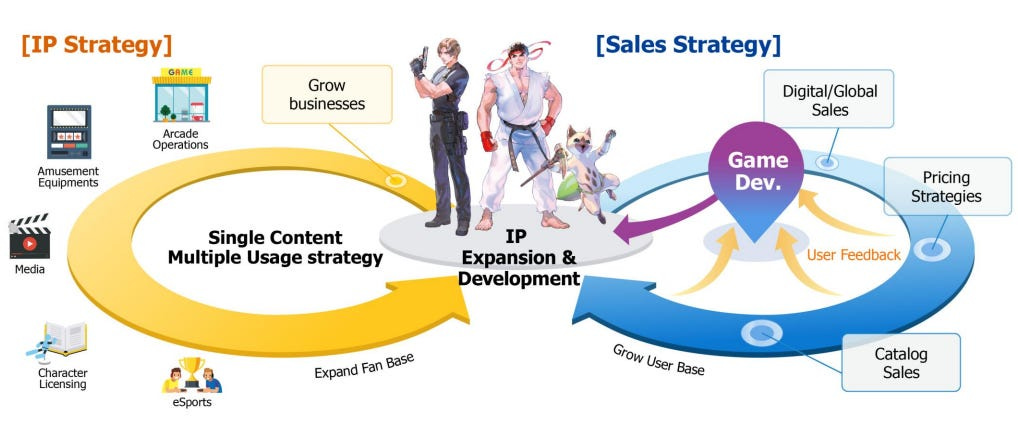
When a new release has to compete with a decade of discounted classics, the money pools at the very top (a handful of viral hits, beloved sequels, and big franchises). Meanwhile, the long tail launches into a market that already has more great games than anyone has time to play.
Still, since H1 closed, Steam has banked another half-billion, taking 2026’s running total to $11.6B.
Let’s look at which new games are driving the new-release slice of that.
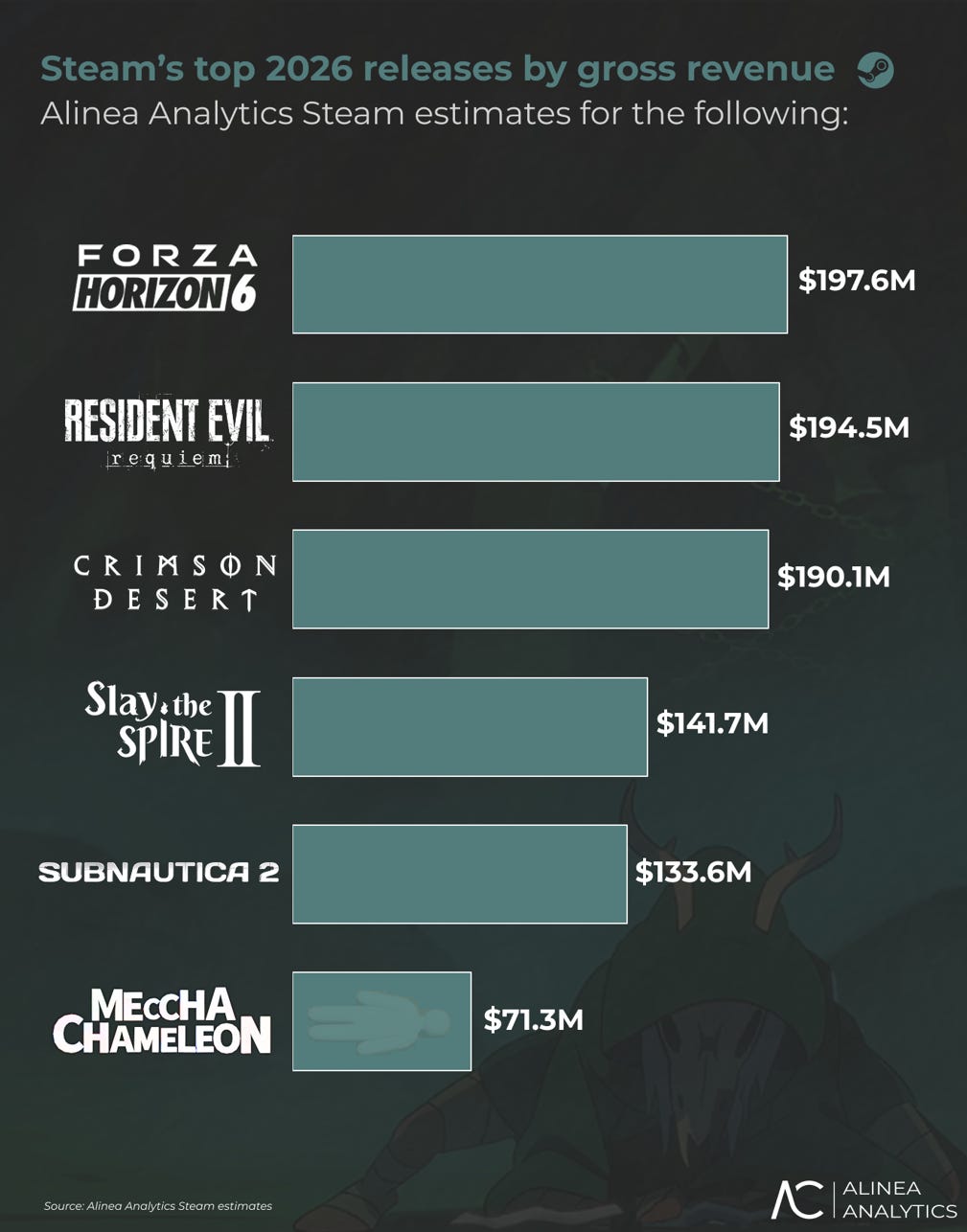
Steam’s top new 2026 games by revenue (so far)
It has been anything but a quiet H1 for revenue hits:
Forza Horizon 6 has driven (ayy) revenues of $197.7M since launching under two months ago, the top new game of the year by Steam revenue. About $4M of that is DLC, including almost $2M from the VIP Membership (double event cash and other perks). Launch-aligned, Forza Horizon 6 is pulling revenue three times faster than 2021’s Forza Horizon 5 did, as much a testament to Steam’s own growth as to the game. 3.5M copies sold.
Resident Evil Requiem has managed $194.5M and 3.4M copies for Capcom on Steam, including $1.3M from the purely cosmetic Deluxe Kit DLC. In total, Requiem has converted just 8.9% of its pre-launch wishlisters so far, which sounds low but signals a long revenue tail, exactly as Resi titles tend to behave on Steam. The slow-burn conversion is the point here, not at all a weakness.
Crimson Desert is just behind Requiem at a little over $190M since its March launch. It’s the standout here because it’s a brand-new IP. But it made about $9.2M last month, so those full-price $70 buys are drying up. If I were Pearl Abyss, I’d get a 20%-off promotion running before the autumn release onslaught. Requiem had its first 20% discount on Steam last month and held revenue essentially flat between May and June as a result, an example of a well-timed discount offsetting this kind of revenue decay.
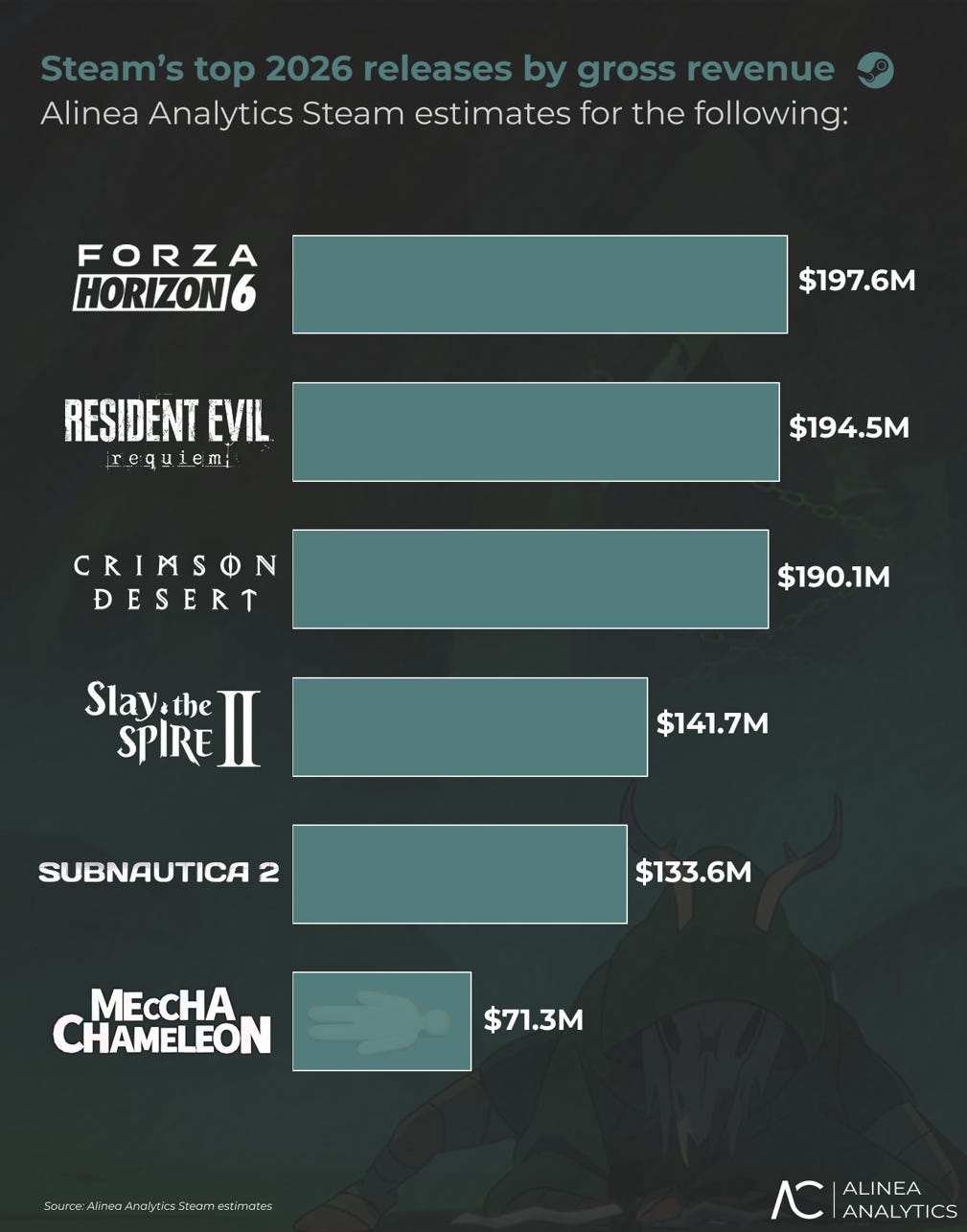
Spot the chameleon Slay the Spire 2 is a volume monster. Four months into early access, it’s sold 7.1M copies, more than Forza Horizon 6 and Resident Evil Requiem combined. But at a $25 price point (and regional equivalents) it sits fourth by revenue with $141.7M. That’s a frankly absurd figure for an indie in early access, and you love to see it. Remarkably, 40% of its pre-launch wishlisters have already converted to buyers, 31% in the first week alone! Slay the Spire 2 launched as a polished, near-content-complete sequel to a beloved game and at a low price, so its wishlist was stacked with players who already knew they wanted in.
Subnautica 2 has pulled in $133.6M so far, roughly $120M of it in May, its early access launch month. The superfans who couldn’t wait for 1.0 have largely already dived in. Content was thin at launch (if still great), so we expect a bigger wave of its 5.6M wishlisters to convert once it hits 1.0. So far only about 12% have converted, versus Slay the Spire 2’s 40%, which is what makes Slay the exception for early access, not the rule.
Meccha Chameleon is continuing to climb, with $71.3M despite a $6 price tag, and 2026’s single top game on Steam by copies sold. It’s had its viral moment, and sales are starting to taper a bit, but it still pulled almost $1M this week, so the two-person team is doubtless still chuffed. A $6 game outselling everything by units while a $70 one tops the revenue chart is the whole modern Steam market in one snapshot.
So Steam is growing while relying less and less on the games launching on it. A record $11.1B half-year, roughly 5x where it sat a decade ago, is increasingly carried by the back catalogue, with new releases now under a fifth of the take.
Obviously, that’s rad for Steam and publishers with deep, revered backcatalogs that’ll keeps earning for years. But for other developers and publishers, especially newer ones looking to launch new AA(A) IP, competing with the best games ever made, permanently on sale a few clicks away … rough.
The winners on the game list above all found an answer to that (a viral hook, a beloved sequel, a franchise with a built-in audience, or a price low enough to be an impulse, or a unique, risky spin on open-world RPGs). But there is no blueprint for success.
While I’m a firm believer that truly great games will always find their audience, everyone is fighting the catalogue in one way or another. And that’s becoming a harder battle to win.

Say hi at Develop!
This time next week, we’ll be in Brighton for Develop!
If you’re also heading over, give me a shout! My DMs are open if you want to chat about games, the games market, data, what Alinea’s been up to, or anything else games-related!
Especially looking to meet indies and folks at publishers, but - as always - I’m down to meet anyone with a passion for games.

If you want to meet you can DM me here, on LinkedIn, or just email me at rhys@alineaanalytics.no.
Want to get your hands on our data for yourself – for free?
We’re offering a free trial of our platform for games companies.
Send us a message here, or reply to this email, and we’ll set you up.
The last word
Reply to this email – or reach out here – if you have any feedback for the newsletter – or want to request a game for us to cover.
[Alinea Analytics boasts the most accurate PC and console estimates in the business. Game makers use our platform to understand their audience, keep an eye on the competition, monitor sales trends, and spot new opportunities. We equip game studios and financial institutions with accurate data and the confidence to make smarter, data-driven decisions. Want to talk about all things games market data? We’d love to chat!]